
 Credit: ( NJDEP via AP)
As wildfires become more common in the era of worsening climate change, they are also turning into a bigger budget challenge for state governments tasked with putting fires out and trying to prevent them from happening in the first place.
That’s one of the main takeaways from a recent report published by The Pew Charitable Trusts that looked at ways wildfires are increasingly “burning through state budgets.”
The Pew report didn’t look specifically at how much New Jersey spends annually to prevent and control wildfires — roughly $7 million in one agency, as well as $2 million more in federal grant money and additional contributions by other state and local services. But it offered up a set of conclusions and recommendations that are likely pertinent for policymakers in New Jersey, since state officials say spending on wildfire suppression has been on the rise here in recent years.
Earlier this year, New Jersey also saw one of its more significant forest fires in over a decade, a mid-June blaze that torched more than 13,000 acres in the fire-prone Pinelands, causing damage that spanned portions of both Atlantic and Burlington counties.
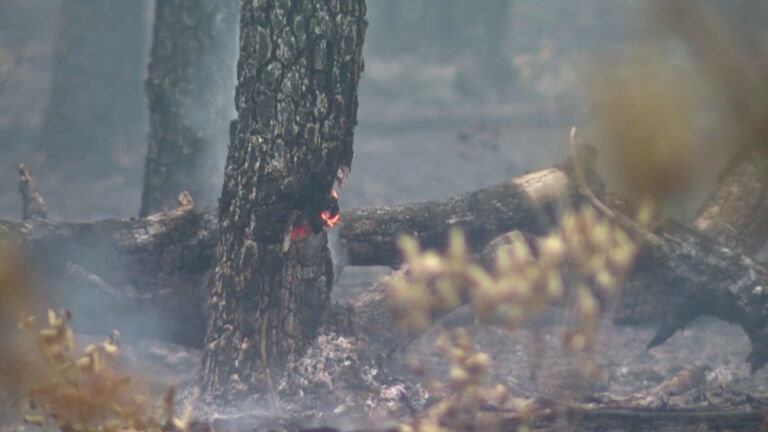
Among the Pew report’s recommendations is a call for a reevaluation of budgeting practices to account for increasing wildfire risk. Investments in evidence-based fire mitigation efforts, such as controlled or prescribed burns, are also emphasized in the report since they can end up saving money in the long run.
The report also stressed the need for improved data collection and dissemination to ensure policymakers know exactly how much it is costing governments to take on the many challenges posed by wildfires.
“All levels of government should better track and report on their wildfire spending,” said Colin Foard, a Pew expert on state and federal natural disaster spending.
“That’s critical information for determining how we can plan and reallocate resources to confront rising risks,” Foard said as he discussed the report Thursday during a webinar hosted by Pew.
Increasing damage
Using data from the National Interagency Fire Center, Pew researchers determined the average annual acreage burned during wildfires in the U.S. from 2017 to 2021 was nearly 70% larger than the annual average from 1983 to 2016.
At the federal level, the combined amount of funding for wildfire activities at both the U.S. Department of the Interior and the Forest Service more than doubled from fiscal years 2011 to 2020, according to the report.
State-level data related to spending on wildfires is generally hard to track, but the researchers looked at places like the state of Washington, whose average annual spending of state funds on wildfires tripled in recent years.
In New Jersey, the peak wildfire season typically begins in late March and continues through early May, depending on rainfall and weather, according to the New Jersey Department of Environmental Protection.
‘All levels of government should better track and report on their wildfire spending.’ — Colin Foard, The Pew Charitable Trusts
But as the climate warms, forest fires are now occurring more frequently outside of the peak fire season, and the season itself is getting longer, officials said.
Funded with $7 million from the state’s more than $50 billion annual budget, the New Jersey Forest Fire Service responds annually to about 1,000 wildfires and an equal amount of additional service calls, the DEP officials said. And supported with federal grant money, the fire service also handles fire prevention, training, preparedness and other operational activities statewide.
About 50% of the total budgeted funding goes to response and suppression, officials said. That covers personnel, equipment, aircraft and operational costs associated with fuel, maintenance and repairs.
Another 20% funds mitigation activities that include prescribed burns, which target “hazard fuels” like excess leaves, pine needles, grasses and other groundcover that enables fire to reach the tree canopy. Other portions of the fire service budget fund prevention and outreach efforts that include the “Smokey Bear” campaign, officials said.
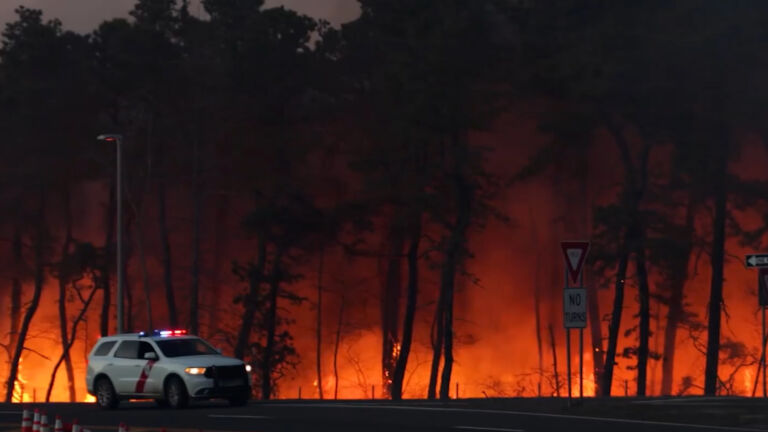
In addition to reducing the fuel that helps feed large forest fires, the prescribed burns also play a role in the state’s carbon defense strategy by reducing uncontrollable fires that can take out significant portions of a forest, resulting in significant carbon loss, according to the DEP.
Removing small trees from the forest is another way to mitigate wildfires, and in recent weeks, the New Jersey Pinelands Commission has authorized a controversial plan that calls for the removal of more than 2 million small trees from Bass River State Forest in Ocean County under a mitigation effort slated to begin next year.
An unchanging budget
Despite the recent lengthening of New Jersey’s peak forest fire season due to climate change, the amount of funding budgeted for the state Forest Fire Service has remained flat for more than a decade, officials said.
That means some of the funding that has historically paid for wildfire mitigation has instead been needed for fire suppression, they said.
In addition to emphasizing overall investment in mitigation activities, the Pew report suggests mitigation can mean more than just prescribed burns and cutting down trees. It lists “community preparation and home hardening” as other effective prevention strategies.
‘States should particularly consider how they track and account for federal reimbursements that can often span multiple fiscal years to better understand the actual cost of wildfires.’ — Pew Charitable Trusts report
And if policymakers are focusing on mitigation activities, that should include “looking for ways to ensure that the immediate need for suppression funding does not directly compete with mitigation investments, which can help manage these costs in the long term,” the report said.
Among the other top recommendations in the report is the suggestion that state policymakers reevaluate their current budgeting practices to account for the increasing risk of wildfires instead of relying too heavily on estimates that look only at past experience.
“By comparing actual spending versus expected spending, assessing the threat of future fires, and implementing other tools, states can more accurately understand how much to budget for wildfire management, including mitigation,” the report said.
