
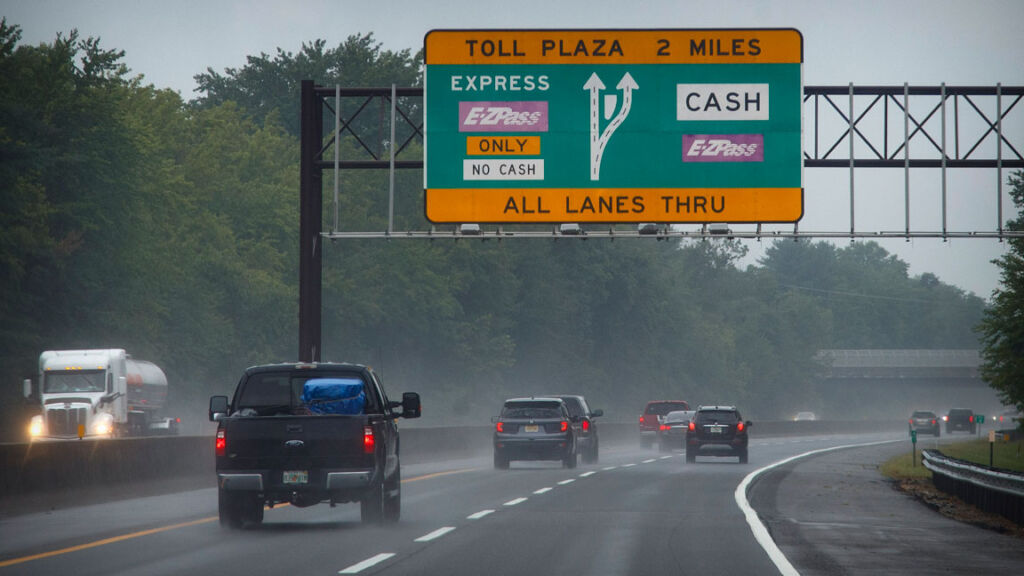
For the second year in a row, tolls will be going up automatically at the start of a new year on New Jersey’s major toll roads.
The increases totaling 3% will go into effect on the Garden State Parkway, New Jersey Turnpike and Atlantic City Expressway on Jan. 1 under operating budgets adopted in recent weeks by the respective agencies that administer the toll roads.
The toll-road operators can hike tolls by as much as 3% annually without holding new rounds of public hearings under a controversial new policy the agencies authorized in 2020.
Earlier this year, the first automatic annual adjustments that are allowed under that policy went into effect on all three toll roads to help support operating budgets and ongoing capital improvements. For example, the average turnpike toll for passenger cars will increase from $4.95 to $5.10 under the latest 3% increase.
Third year in a row
The 2022 increases followed larger toll hikes that were enacted in 2020, also as major new capital investments were being proposed. That makes the 2023 increases the latest to occur within a matter of only a few years.
Allowing the incremental toll increases to occur automatically each year is supposed to give the toll-road operators more flexibility to ensure revenues match or exceed annual expenditures and debt service. That’s something a major Wall Street credit-rating agency noted in a recent review of a New Jersey Turnpike Authority bond issue.
Through the end of September, the turnpike authority’s toll revenue totaled nearly $1.6 billion, according to agency records. Last year, the authority generated about $2 billion in toll revenue, which bested 2020’s $1.4 billion, according to the agency records.
The latest automatic hikes will come as many New Jersey motorists will also be facing rising costs at Hudson River crossings operated by the Port Authority of New York and New Jersey.
But while it may be good policy for toll-road operators and investors, the practice of allowing the automatic increases also has its detractors. A bipartisan bill introduced in the Legislature earlier this year would prohibit the New Jersey Turnpike Authority from implementing annual increases. Some sponsors and other critics have suggested the automatic increases heap new costs on New Jersey residents when many are already struggling to make ends meet during a period of high inflation.
The turnpike authority increased tolls during the first year of the COVID-19 pandemic to help support an ambitious capital plan that is funding major highway-widening projects and a series of other long-term investments. In all, tolls went up by 36% on the turnpike and 27% on the parkway in September 2020.
The South Jersey Transportation Authority, which operates the Atlantic City Expressway, also hiked tolls in 2020, and both agencies at the time also set the stage for the annual, 3% increases to occur automatically, starting on Jan. 1, 2022.
Other toll increases
The latest automatic hikes will come as many New Jersey motorists will also be facing rising costs at Hudson River crossings operated by the Port Authority of New York and New Jersey. Those planned increases at the George Washington Bridge and Holland and Lincoln tunnels are also scheduled to go into effect on Jan. 1.
And New Jersey motorists are still waiting to see what happens next as officials in New York move ahead with plans to charge a “congestion toll” when motorists enter Manhattan’s central business district, including from New Jersey’s side of the Hudson River.
‘While other states are devising ways to help their people survive this economic crisis, Governor Murphy and the state of New Jersey are exacerbating this dire situation by making it more expensive to travel.’ — U.S. Rep. Jeff Van Drew (R-2nd)
In recent weeks, both houses of the New Jersey Legislature have approved symbolic resolutions to express opposition to a plan that would make New York City the first in the nation to implement what’s commonly referred to as congestion pricing.
When it comes to New Jersey’s toll roads, allowing the modest annual increases to go into effect should “remove the need for periodic large rate increases,” Fitch Ratings analysts said earlier this month as they gave the turnpike authority’s bond issue an “A+” rating.
Looking for a rollback
However, the bipartisan bill that was introduced earlier this year takes a different view. It calls for rolling back by 50 cents the turnpike and parkway toll increases enacted in 2020, in addition to banning automatic annual increases.

The same measure would also ban the turnpike authority — whose revenues in recent years have increasingly been used to subsidize New Jersey Transit’s operating budget — from enacting another toll hike “until after December 31, 2024.”
Republican U.S. Rep. Jeff Van Drew (R-2nd) — himself a former state lawmaker — is among those who have been speaking out against the latest automatic toll increases.
Van Drew noted in a recent news release that the increases will come at a time when inflation has been running at or near historic highs. He also pinned blame on Democratic Gov. Phil Murphy since the governor has the power to veto actions taken by the toll-road operators.
“While other states are devising ways to help their people survive this economic crisis, Governor Murphy and the state of New Jersey are exacerbating this dire situation by making it more expensive to travel,” Van Drew said.
