
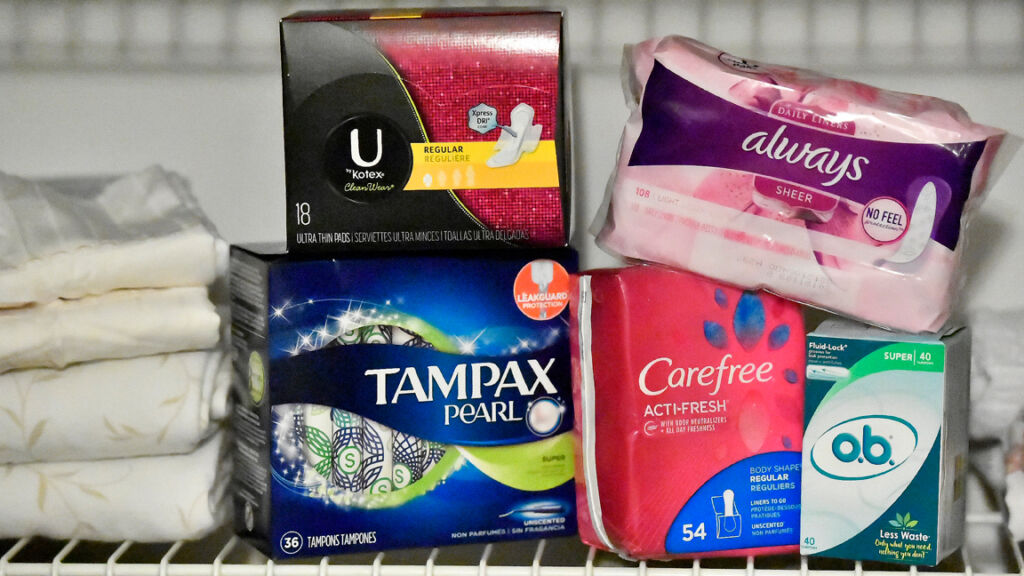
 Credit: (AP Photo/Mike Stewart)
What started as a student public policy project on menstrual inequity worldwide led one New Jersey high school to take small but crucial steps to address “period poverty” here at home.
Since fall 2019, Bergen County Technical High School has stocked bathrooms with free menstrual products so that all students have easy access to sanitary supplies and won’t miss class or after-school programs when they have their period.
The tech school officials and project leaders — now college sophomores — are encouraging other New Jersey school districts to follow their lead. They joined other health care advocates Thursday to support legislation to expand access to free menstrual products, give consumers more information about these items and boost screenings for certain reproductive health issues. These were among their measures to address so-called period poverty, defined as a lack of sanitary products or understanding about menstrual health.
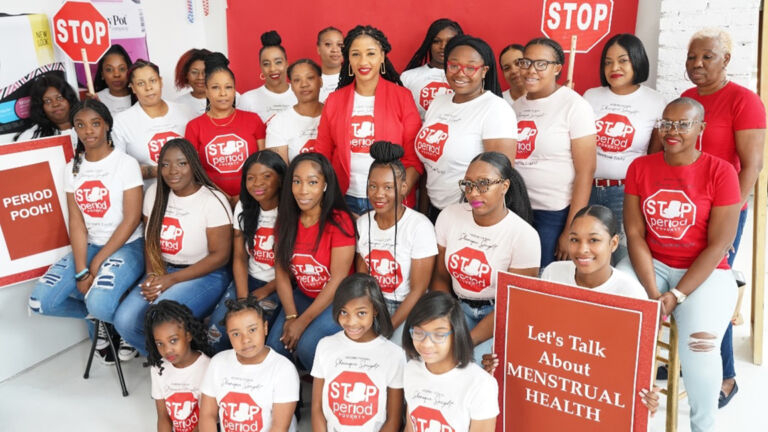
“Period products should not be treated any differently from toilet paper, paper towels or even tissues,” former Bergen Tech student Lexi Palumbo told members of the Assembly Women and Children Committee. Palumbo, who is in school at Susquehanna University, worked with Alisha Veera, who now attends Cornell University.
The committee voted unanimously to pass all eight bills related to period poverty Thursday. These now require action in the Senate and a full Assembly vote before they could go to the governor to be signed into law. “It’s important for us to remember menstrual products are not a luxury, but a health care necessity,” said Assemblywoman Gabriela Mosquera (D-Gloucester), the panel’s chair.
Racial gaps in women’s health
The measures reflect a growing focus — nationwide and in New Jersey — on women’s health in general and on the racial disparities in access, treatment and medical outcomes. Nationwide, Black women are as much as four times more likely to die during pregnancy or childbirth and face 40% higher fatality rates for breast cancer, when compared to white women, statistics show. Black women are also at higher risk for uterine fibroids than women of other races. Additionally, in the U.S., Black people are also more likely to get seriously ill and die of COVID-19 than white people, given their greater likelihood of exposure to the disease, less access to treatment and the impact of racism throughout our health care systems.
‘Period products should not be treated any differently from toilet paper, paper towels or even tissues.’ — Lexi Palumbo, former Bergen Tech student
To address these concerns in New Jersey, first lady Tammy Murphy launched Nurture NJ, a public campaign to halve maternal deaths and eliminate the racial gaps in outcomes here — among the nation’s highest — by 2025. Lawmakers, led by Assemblywomen Shanique Speight (D-Essex) and other female lawmakers have been sounding the alarm for years about inequities in maternal care. The state has increased spending on efforts to reduce these gaps, with $33 million in the current budget for Nurture NJ programs.
Now Speight is leading the fight against period poverty in New Jersey, part of nationwide efforts to expand awareness of menstrual health and justice; Assemblywoman Lisa Swain (D-Bergen) is also working on related legislation. Speight said a bout of homelessness as a child helped her appreciate the need for accessible supplies. Speight now holds “period packing parties” with friends, family members and supporters sorting pads and tampons to create kits they distribute to women’s shelters and schools in Newark and Belleville.
The Assembly Women and Children Committee approved a measure that would create a statewide screening program to help women at risk for endometriosis and polycystic ovary syndrome.
“These bills will help remove the shame and stigma associated with menstruation,” Speight told the committee, noting that some women are forced to use cloth rags, toilet paper or plastic bags when they can’t afford sanitary products. “We cannot expect people who are experiencing food and housing insecurities to be able to afford the cost of menstrual health products. Periods can be difficult and expensive to manage.”
Menstrual disorder screenings
But menstrual health goes beyond access to products, Speight said. The committee approved one measure (A-3212) — sponsored by Speight and Assemblywomen Angela McKnight (D-Hudson), the panel’s co-chair who does period poverty outreach in Jersey City, and Verlina Reynolds-Jackson (D-Hunterdon) — that would create a statewide screening program to help women at risk for certain menstrual disorders, including endometriosis and polycystic ovary syndrome, a leading cause of infertility. These conditions can cause debilitating pain and heavy periods, among other complications, and are often undiagnosed, Speight said, leaving some women suicidal.
The committee also passed a bill to require the state to supply free menstrual products through food pantries, child welfare programs and the state’s Medicaid program, NJ FamilyCare, and would appropriate $2 million; another measure pressures the federal government to take these efforts nationwide. Other legislation approved would require period products to be available for free at women’s shelters and other programs for homeless people, enable the state to purchase these items in bulk, and require ingredients to be clearly listed on the products’ box.
‘These bills will help remove the shame and stigma associated with menstruation.’ — Assemblywoman Shanique Speight
While none of the proposals specifically called for schools to stock free period products, lawmakers hope the changes will benefit young women through other avenues. All the bills received support from Bergen County Tech representatives and various public health advocates, including the National Organization for Women.
Some schools appear to be taking steps on their own to make sanitary supplies more accessible. Palumbo and Veera’s work for their class in 2018 prompted Leonia High School to follow suit, according to their former law and justice teacher Genevieve Allard. Since 2019, when Bergen Tech installed five dispensers stocked with products — for “an absolutely negligible” cost of $3,000 to date — more than 1,000 students have had access to the free supplies, principal David Tankard told the committee.
“It operates just like stocking the toilet paper and other products,” Tankard said. “This to me is a moral and educational obligation long overdue.”
Veera encouraged lawmakers to consider requiring New Jersey’s high schools to provide pads and tampons for free. New York state required schools for students grades 6 through 12 to make these available at no cost starting in 2018, she said, and 16 other states and Washington, D.C. have since followed suit. “I humbly hope New Jersey joins the fight,” Veera said.
— Editor’s note: This story has been updated to correct the spelling of names.
