
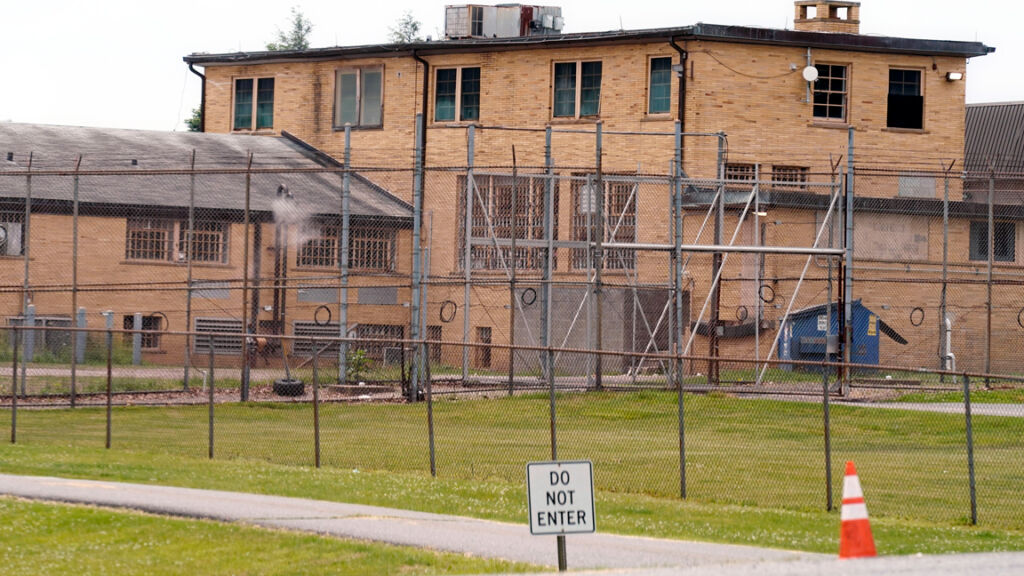
All 14 former New Jersey corrections officers charged in the assaults on inmates at the state women’s prison in January 2021 have now been indicted.
It’s the latest step in the investigation into an incident that led to a shake-up at multiple levels of leadership at New Jersey’s only prison for women and a vow to close the century-old facility.
The state attorney general’s office announced that all those arrested were indicted on Tuesday on crimes that include conspiracy, official misconduct, tampering with public records and, most seriously, aggravated assault. Those indicted included the official in charge at the Edna Mahan Correctional Facility for Women in Hunterdon County on the night forced cell extractions resulted in several women suffering serious injuries and having to be taken to the hospital.
At the time of the assaults, the prison facility was already the subject of a federal investigation into sexual assaults on inmates by officers.
Sean St. Paul, 56, of Newark, was an acting administrator during the overnight hours of Jan. 11 to 12, 2021 and was the highest-ranking official indicted. Thirteen other officers ranging in age from 22 to 44 also were indicted. All were arrested in the months following the assaults, which prompted multiple state investigations.
Investigations yield resignations
Lawmakers in a joint hearing by two Assembly committees months after the assaults were highly critical of Dan DiBenedetti, the corrections ombudsman at the time. DiBenedetti did not use the broader investigatory powers given to him by the 2020 Dignity Act and did not visit Mahan following the incident. He announced his retirement the day after that hearing. An independent report in June 2021 portrayed then-corrections commissioner Marcus Hicks as out of touch and unaware that Mahan had no permanent administrator leading up to and on the night of the assaults. Hicks resigned the day after the report was issued.
Officers at Mahan forcibly pulled inmates from their cells after they squirted unknown liquids through their cell doors at guards. But according to state Department of Corrections policy, officers should only use force when inmates refuse orders to put on handcuffs and leave their cells or if they pose a threat to themselves or others. Prosecutors say the officers had planned to use force regardless whether women resisted and in some cases did not even give the inmates an opportunity to comply with orders.
Videos capture violence
One inmate wound up in the hospital with a concussion after she was punched almost 30 times by an officer and shoved or had her hair grabbed by other officers despite no apparent provocation or physical resistance, an investigation found. Another woman who complied with orders also was taken to the hospital where doctors found her skull broken around her eye and boot marks on her body. Videos released by the attorney general’s office in July 2021 showed some of the violence.
‘The New Jersey Department of Corrections has zero tolerance for abuse or mistreatment of the incarcerated population,” — DOC spokesman Dan Sperrazza
The indictment alleges the officers planned, supervised, participated in or failed to stop “one or more forced cell extractions on the Restorative Housing Unit tier with the purpose of punishing, intimidating or terrorizing one or more inmates.” They are also accused of facilitating, failing to intervene in the assaults and failing to report them, as is their duty as law enforcement officers. Investigators allege that internal reports generated about the incident were false or misleading in an attempt to conceal the brutality and what led to the assaults.
Dan Sperrazza, a DOC spokesman, said that all those indicted were initially suspended during the investigation and, once charged, placed on administrative leave without pay. If convicted, the officers face penalties ranging from three-to-five years in prison and a $15,000 fine for tampering with public records to five-to-10 years in prison with a requirement to serve at least 85% of that time and a $150,000 fine for aggravated assault, according to the attorney general’s office.
“The New Jersey Department of Corrections has zero tolerance for abuse or mistreatment of the incarcerated population,” Sperrazza said. “The indictment against these 14 individuals demonstrates the severity of their actions and violation of responsibility in maintaining the safety and care of incarcerated persons in their custody.”
The DOC was in the process of upgrading the cameras around Mahan at the time of the assaults. Victoria Kuhn, who replaced Hicks, has put a number of reforms in place, including increased training for officers and requiring all those who have contact with inmates to wear body cameras. Many focus on “cultural changes,” she told incarcerated individuals and the public during a meeting earlier this month marking the end of the first year of federal monitoring that was part of a settlement of a federal civil rights complaint over the sexual assaults. During that meeting, Kuhn also said she expected the final recommendation for a new facility to replace Mahan would be released soon and the new prison would incorporate “advancements in prison reform,” including improved areas for visitation, reentry programs and long-term care.
Terry Schuster took over as corrections ombudsman four months ago and released the office’s first report earlier this month on the sweltering temperatures inside the system this summer. During the meeting, Schuster told the audience how his office plans to fulfill its role as a watchdog under the Dignity Act.
“We’re coming up with our plan now for moving forward, which will be a combination of answering calls from incarcerated people and from family members for individual calls for help and complaints to see if we can be helpful,” he said, “for doing some systemic issue monitoring related to safety and health care and access to loved ones and engagement and personal, purposeful activity.”
