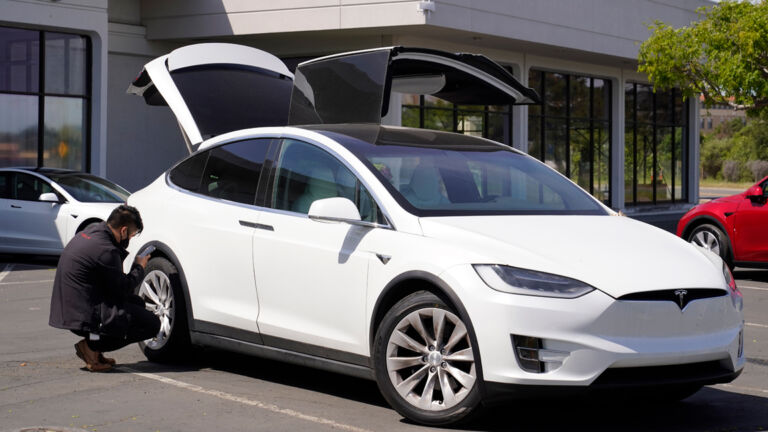
Credit: (Patrick Pleul/Pool via AP, File)
The news about Tesla CEO Elon Musk’s recent professional and personal behavior appears to know no end.
For a company with a customer base as diehard as Tesla’s, it is surprising to see the #BoycottTesla push on social media, and that Musk’s actions are making the idea of ever owning a Tesla incomprehensible for some drivers.
Nevertheless, the vast majority of the Tesla community remains unaffected by their beloved brand’s brash leader. Across the U.S., sales of Teslas have skyrocketed in the last five years and are continuing to grow, thanks in large part to the 2017 introduction of the more affordable Model 3.
It is becoming clear, however, that America’s growing appetite for cheaper electric vehicles may be the thing that erodes Tesla’s market share. Though not yet exploding like those of the Model 3, sales of economy electric vehicle models from legacy car manufacturers like Hyundai, Kia, Chevy and Ford are on the rise, along with those of lesser-known luxury brands like Rivian, Genesis and Lucid. And soon-to-be released pick-up models, like the Ford F-150 Lightning and Chevy Silverado EV, are generating massive pre-orders.
Helping NJ governor achieve green goal
Future roads and highways full of just this sort of EV diversity is exactly what the Murphy administration has been banking on for the past several years — and is now investing in significantly.
Early in his first term, Gov. Phil Murphy set a goal that, by 2025, New Jersey would have 330,000 plug-in electric vehicles on the road. Three years ago, his administration created the Charge Up program, offering rebates of up to $4,000 for the purchase or lease of a new electric vehicle, and it is has also aggressively pushed to get charging stations installed throughout the state.
Sales of economy electric vehicle models from legacy car manufacturers like Hyundai, Kia, Chevy and Ford are on the rise, along with those of lesser known luxury brands like Rivian, Genesis and Lucid.
The program has been successful — between May 2020 and May 2022, more than $50 million was spent on rebates for all-electric and plug-in hybrid vehicle purchases. That amount, Murphy said last week, accounted for the entirety of the program’s allocated rebate funds.
On Monday, Murphy announced that an additional $60 million in incentives will be made available for Charge Up, with higher rebates reserved for cars costing less than $45,000. There’s also a new program offering $250 rebates for the installation of home charging stations.
“I’m proud that my administration is doing everything in its power to make the transition to electric vehicles more financially feasible and practical for working families across the state,” Murphy said at a news event in Asbury Park. “As we enter Year Three of the Charge Up New Jersey EV incentive program, we remain determined to meet our bold clean energy goals and are confident that thousands more New Jerseyans will take advantage of a program that will continue to bear considerable economic and environmental benefits.”
Some of the governor’s detractors are not convinced by the Charge Up program. In a tweet Tuesday, Sen. Edward Durr (R-Gloucester) said the initiative will not benefit many New Jerseyans.
“Even with #TaxCredits most NJ citizens cannot afford these EVs,” Durr wrote. “We need every resource we have. Invest in oil/gas/nuclear along with wind & solar, diversify!”
Sales in wealthier counties
There is little dispute that sales of plug-in and hybrid electric vehicles in New Jersey are soaring. According to the Department of Environmental Protection, hybrid and all-electric vehicle registrations have increased from 14,211 in 2017 to 64,307 in 2021.
But those registrations are disproportionately concentrated in the state’s wealthier and more populous counties — Bergen, Middlesex, Essex, Morris, Somerset, and Monmouth. For example, in Bergen County, which has the state’s fourth-highest per capita income, there were 9,363 sales of all-electric and plug-in hybrid vehicles in 2021. However, in Salem County, which has the state’s fourth-lowest per capita income, there were 182 combined sales.
While Tesla’s Model 3 continues to dominate the market — in 2018, the Model 3, which today starts at $48,490, accounted for 50% of the U.S. market share, according to the Department of Energy — it’s clear that charging stations will be looking a lot more diverse in the coming years.
For perspective, the state’s Charge Up website lists 18 battery-only options that are now eligible for rebates. The cheapest is the Nissan LEAF, which starts at $27,800 and qualifies for a rebate between $2,600 and $4,000. An additional 13 plug-in hybrid models are also eligible for rebates — the cheapest being the base model Toyota Prius, which is listed for $28,670 and qualifies for a $625 rebate.
View from the showroom floor
Reached by phone Tuesday, a salesman at a Gloucester County Ford dealership, who would not share his name because he hadn’t been authorized to speak to the media, said inquiries about the availability of new electric vehicles are intensifying.
“We’ve had more interest than vehicles,” the salesman said, noting that he had just gotten off the phone with the potential buyer of an F-150 Lightning.
Given his dealership’s location in South Jersey, the model his customers seemed to be most interested in is the Ford pickup, which generated over 200,000 reservations — and a three-year wait for some — when the company announced the model in 2021, prompting the manufacturer to shut down orders for a period. So far, only 2,296 F-150 Lightnings have hit the road countrywide.
“We’re on the edge of a rural market, as far as New Jersey standards go,” the salesman said.
People don’t seem ready to make all their household’s cars fully electric, the salesman continued, due to what he called “range anxiety,” but he did say that his typical customer is “ready to go waist-deep with EV or hybrid,” meaning customers still want a combustion-engine car as their primary vehicle and an all-electric or plug-in hybrid as their backup — or local — mode of transportation.
With Murphy’s announcement of new funding for the Charge Up program, the salesman predicted he would be receiving more calls like the one he’d had earlier in the day.
“I’m sure that’s going to drive interest up even more,” he said. “I wish inventory levels were different.”