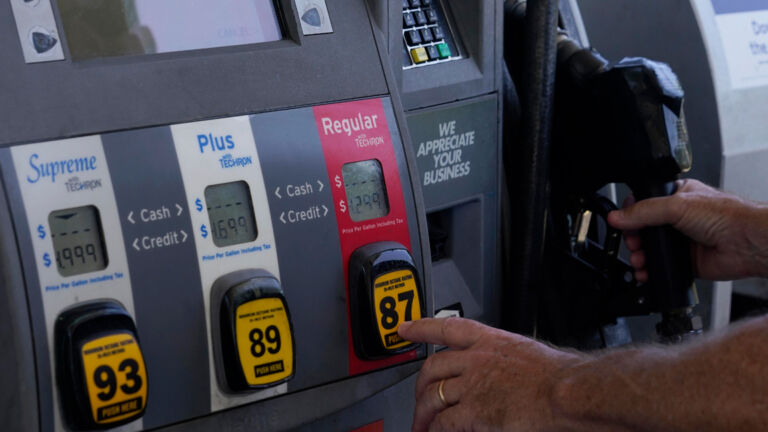
Credit: (AP Photo/Marta Lavandier)
New Jersey’s gas tax will soon be lowered slightly, and that’s due, in part, to better-than-expected gasoline consumption since the onset of the COVID-19 pandemic.
A legally required, 1-cent reduction of the state’s per-gallon gas tax was announced by the Department of Treasury on Monday. It goes into effect Oct. 1.
Last year, the gas tax was reduced by 8.3 cents, and with this latest automatic reduction, the per-gallon rate will be 41.4 cents.
Although modest, the pending tax reduction will keep the momentum going for motorists who have been seeing some additional relief, as average gas prices have dropped by more than $1 in New Jersey since spiking to record highs in June.
In all, the pending reduction will effectively cancel out a more than 9-cent gas-tax increase that was enacted in 2020.
This year’s slight tax cut also reflects the confidence key state public-finance officials have about gasoline consumption continuing to rise after a major drop-off at the onset of the pandemic.
“We are pleased that this dedicated funding stream continues to provide billions of dollars across the state to support our critical transportation infrastructure needs,” Treasurer Elizabeth Maher Muoio said in Monday’s announcement.
What is the forecast for gas consumption?
In New Jersey, the state gas tax can automatically change from year to year under a 2016 law that linked the per-gallon tax rate to annual consumption. That was done to ensure the tax can generate enough dedicated funding to keep pace with the state’s planned annual spending on transportation infrastructure.
Under the law, New Jersey’s leading public-finance officials, including the treasurer, must meet every August to analyze the latest consumption trends. They are also legally required to apply a formula and make adjustments to the rate to keep annual revenues in line with projected infrastructure spending, which totals about $2 billion a year.
This year’s gas-tax analysis concluded revenue collections over the 2022 fiscal year, which ended June 30, were slightly ahead of projections, yielding a small surplus, according to Treasury.
Meanwhile, the forecast for the current fiscal year, which began July 1, calls for continued improvement, easing pressure on the revenue side and allowing for the slight tax decrease.
In all, the pending reduction will effectively cancel out a more than 9-cent gas-tax increase enacted in 2020. That increase was needed to make up for losses at the onset of the pandemic and after Gov. Phil Murphy ordered a series of economic shutdowns to help slow the rate of new COVID-19 infections.
And while gas-tax collections have still not returned to pre-pandemic levels, the recovery was “better than expected” during the 2022 fiscal year, according to Treasury officials.
However, as many residents are continuing to work from home, the state has yet to match the gas-tax levels recorded in 2016, when New Jersey’s transportation-finance law was last overhauled.
‘We are pleased that this dedicated funding stream continues to provide billions of dollars across the state to support our critical transportation infrastructure needs.’ — Treasurer Elizabeth Maher Muoio
Gas prices surged in New Jersey and across the country earlier this year at the start of Russia’s ongoing military invasion of Ukraine. That helped generate record-high per-gallon rates that topped $5 in New Jersey in mid-June.
But the average price of a gallon of gasoline in the state was just under $4 as of Monday, according to AAA data. Despite the recent improvement, gas prices remain about 75 cents higher, on average, compared to this time last year, according to the AAA data.
Transportation trust fund
In addition to rewriting state transportation-finance law in 2016, former Gov. Chris Christie and lawmakers also increased the state’s per-gallon gas tax, from 14.5 cents to 37.1 cents, as part of a broader effort to renew the state’s Transportation Trust Fund for another eight years.
Funded primarily with dedicated revenue from the gas tax, the trust fund is a separate account from the state budget that ensures New Jersey has enough money on hand to maintain its extensive network of roads, bridges and mass-transit infrastructure on an annual basis.
Earlier this year, some lawmakers called for a temporary gas-tax suspension in response to the record-high prices. But Murphy, a second-term Democrat, never got on board, citing the impact it could have on the trust fund.
The trust fund will come up for reauthorization once again in mid-2024. But so far, there’s been little public discussion of that next reauthorization, including how heavily it should rely on revenue from the gas tax to sustain annual spending on transportation infrastructure.
Murphy and lawmakers have been trying to promote the use of electric vehicles in response to growing concerns about climate change since they are better for the environment. But motorists who drive electric vehicles are not regularly contributing to the maintenance of the state’s transportation network because they escape the gas tax.