
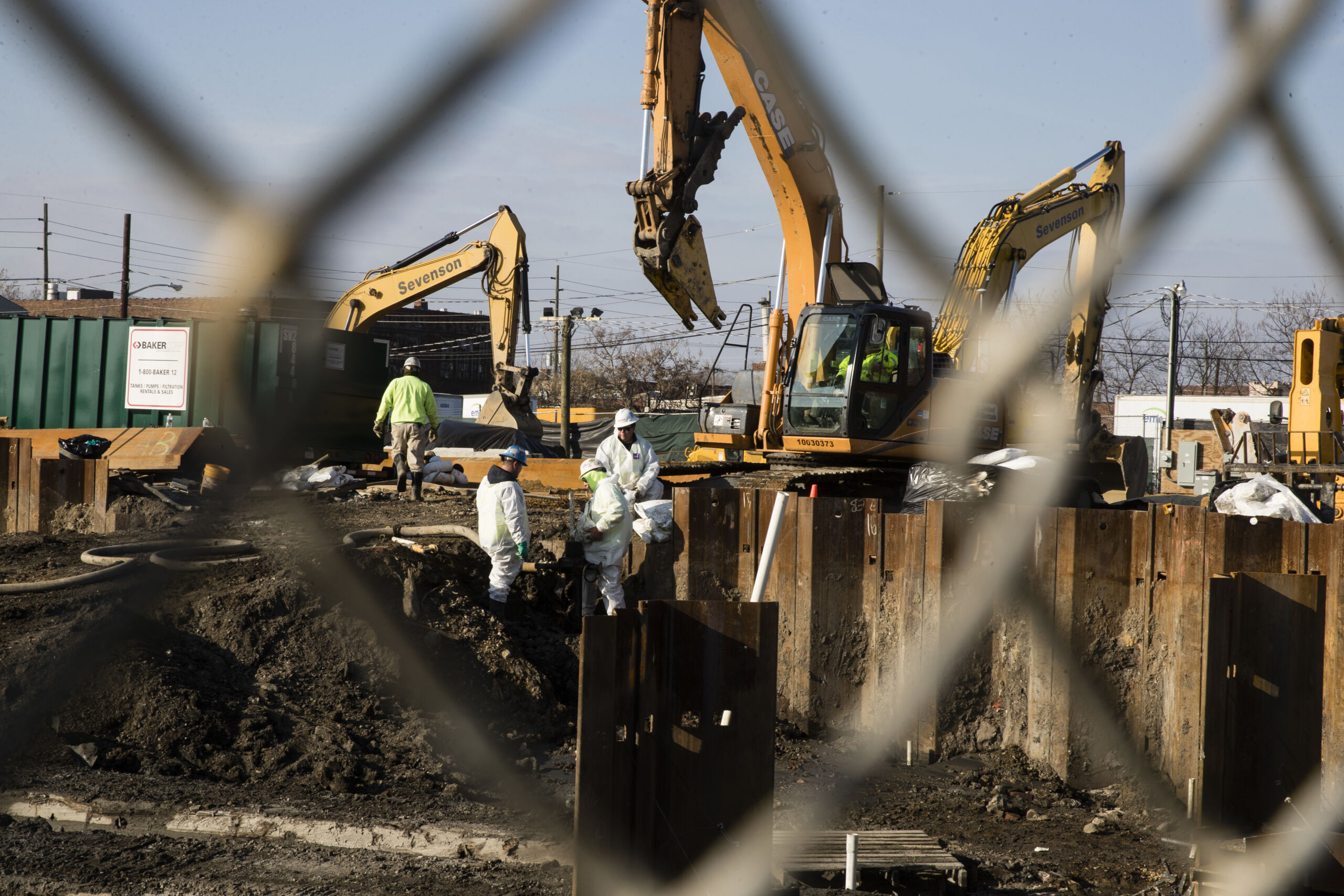
 Credit: (AP Photo/Matt Rourke)
New Jersey filed its latest lawsuit seeking compensation for alleged damages to the environment, this time claiming that Monsanto and two former affiliates produced toxic PCBs that leaked into the state’s air and water over almost 50 years.
The lawsuit says the companies caused “significant, long-term damage” to the state’s waterways and ground water, as well as to soil, air and wildlife by allowing and encouraging disposal of the chemicals that they knew to be hazardous at Monsanto’s plant beside the Delaware River in Bridgeport, Gloucester County.
The companies advised their customers to dispose of PCB waste directly into sewers and to vent the chemical vapors into the atmosphere despite knowing that the actions would cause environmental contamination and expose residents to substances that are linked to health complaints, including liver damage, respiratory infections and some cancers, the suit said.
“PCB contamination has harmed natural resources and threatened the health of humans and wildlife in every corner of New Jersey, from remote rural areas to suburban neighborhoods, to our cities,” said acting Attorney General Matthew Platkin, in a statement last week.
First of its kind
It’s the state’s first suit alleging that PCBs damaged the natural environment.
The Murphy administration has now filed 19 “natural resource damage” lawsuits against industrial polluters, alleging long-term damage to the environment and public health and seeking a court order for the companies to pay for the investigation and cleanup. None of the lawsuits has so far been resolved, according to the attorney general’s office.
In 2019, the state sued Sherwin-Williams claiming it discharged waste products from manufacturing paints, lacquers and varnishes into a Camden County creek. Contamination at this location, along with lead and arsenic, also led the U.S. Environmental Protection Agency to designate it a Federal Superfund site in 2008. It became one of New Jersey’s 114 Superfund sites, the most of any state.
Also in 2019, the state sued Handy & Harman Electronic Materials Corp. for allegedly discharging hazardous materials including TCE (trichloroethylene), a degreasing chemical, into groundwater near its factory in Bergen County in the 1980s.
Tougher than Christie
Overall, the actions signal that the Murphy administration is taking a more aggressive stance against corporate polluters than its predecessor, the Christie administration, which filed no such suits.
Jeff Tittel, former director of the New Jersey Sierra Club, welcomed this latest lawsuit but said the state would have a better chance of winning such legal challenges if the state Department of Environmental Protection had a regulatory framework that addressed corporate responsibility for damage to natural resources.
“The DEP has never developed rules and standards for natural resource damages,” he said. “Not having clear standards in place hinders our ability to prosecute these cases to the extent that we need to.” The absence of such regulations also limits the amount of money that the state can seek in damages and makes settlements more likely, he said.
“The AG is taking the right approach by suing; the DEP has a lot of work to do to move these things along,” Tittel said.
That criticism was echoed by the Chemistry Council of New Jersey, which said the DEP has failed to comply with a 2004 agreement between the attorney general’s office and plaintiffs, including the council, to develop regulations on natural resource damages and to stop filing those cases until such regulations are published.
Calling out the DEP
“The current administration has ignored this agreement, and has restarted the program, even in the continued absence of regulatory authority,” the council’s Executive Director Dennis Hart said in a statement Friday. “The NJ DEP should not be skirting their responsibility to develop regulations and allowing private law firms to negotiate on behalf of the state.”
The state Attorney General’s office declined to comment on the Chemistry Council’s claims that DEP lacks the regulatory authority to file natural resource damage suits.
Meanwhile, the new lawsuit says Monsanto manufactured, marketed and sold PCBs – formally known as polychlorinated biphenyls – from about 1929 to 1977, and that the company was responsible for virtually all of those chemicals sold in the United States.
The complaint alleges that hundreds of bodies of water in New Jersey spanning more than 6,000 river miles and more than 14,000 lake acres, as well as 400 square miles of bays and estuaries, have been damaged by PCB contamination.
Monsanto persisted in discharging PCBs even though it knew for decades that they were dangerous, according to the 120-page complaint, filed in Superior Court in Gloucester County on Thursday. In the 1950s, the company’s medical officer advised employees not to eat lunch in the PCB department because the chemicals are toxic.
Bayer, a global life sciences company that acquired Monsanto in 2018, rejected the claims made by New Jersey, and said it should not be required to pay cleanup costs. “We are reviewing this lawsuit and will respond to the complaint in greater detail at the appropriate time; however, we believe it is without merit and the company should not be responsible for the alleged remediation costs.
“Monsanto voluntarily ceased its lawful manufacturing of PCBs 45 years ago — that were once required by many electrical and building codes — and these materials were used in a variety of finished products that were manufactured by third party companies who were customers of Monsanto at the time. Where it has been determined that PCB-related response activities are recommended, federal and state authorities employ an effective system to identify dischargers and allocate response cost responsibilities.”
The two other defendants, Solutia and Pharmacia, have since been taken over by other companies, and could not be reached.
Monsanto has acknowledged the potential for “nearly global” contamination from the chemicals, the state says in its lawsuit. But it decided to keep producing them because “there is too much customer/market need and selfishly too much Monsanto profit” to warrant discontinuing PCB production, the complaint said.
Banned in the 1970s
Before being banned in the 1970s, the manmade chemicals were used in a variety of manufactured goods, including paints, caulks, inks, lubricants and coolants. They are among a cocktail of contaminants that foul a 17-mile stretch of the lower Passaic River in Newark where the EPA is planning a massive and long-delayed remediation costing more than $1 billion.
Shawn LaTourette, commissioner of the Department of Environmental Protection, said he supports companies that contribute to the state’s economy but not those that pollute the environment.
“Some businesses that created harmful chemicals that now litter our environment have never been held fully accountable for the damage they left behind,” he said. “We are calling on Monsanto to finally repair this damage.”
Monsanto violated three environmental laws, according to the lawsuit. The state asked the court to issue an order holding the company liable for pollution with PCBs, directing it to investigate and clean up the contamination, and pay the full cost of restoring damaged natural resources. It also calls for punitive damages to be awarded.
–Editor’s note: This story has been updated to include a statement from Bayer that was received after publication.
