
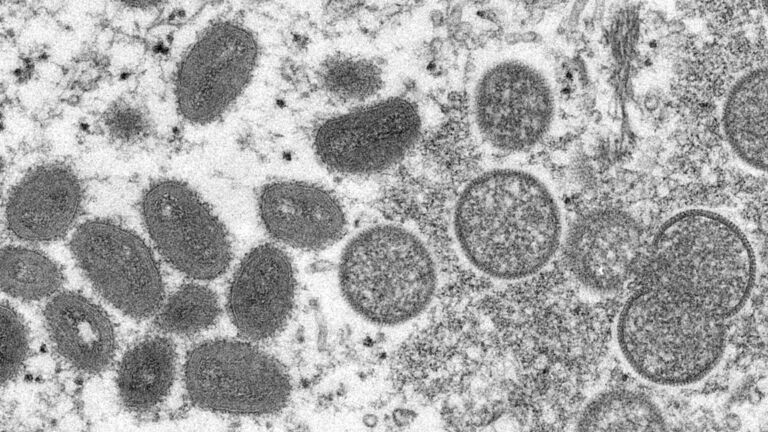
 Credit: CDC / Cynthia S. Goldsmith, Russell Regnery
New Jersey stepped up its monkeypox response by expanding eligibility to vaccines that protect against infection and can prevent symptoms from developing in people who have been exposed to the virus.
Officials — who had been criticized for what some said was a lackluster response — announced Tuesday afternoon that the state will distribute 2,700 doses of the vaccine to local health departments to help protect those who are at particular risk for monkeypox. The rare though rarely fatal virus has been diagnosed in nearly 2,000 people nationwide, including 45 in New Jersey. Previously, the vaccine, which involves two doses administered a month apart, was only available to those who had been infected.
“New Jersey has been given a very limited number of doses at this time and the department continues to press the (federal government) on timely delivery of additional necessary doses to meet the needs of our at-risk populations,” said state Health Commissioner Judy Persichilli. “At the same time, residents should be aware of the signs and symptoms of the orthopoxvirus (which causes monkeypox) and take precautions to prevent the spread.”
Better public messaging needed, gay community and health advocates say
The outbreak — the second in this country — primarily involves men who have sex with men, but health officials stress monkeypox is not a sexually transmitted infection or limited to the gay community. It can take a week or more for symptoms of the virus to show. These often start with fever, aches and swollen lymph nodes and can be followed by a rash or pimple-like poxes, which scab over after seven to 10 days. The virus can be transmitted through direct contact with the poxes and respiratory secretions shared during kissing or cuddling, but it is not yet known if it is passed through semen or vaginal fluids, according to the federal Centers for Disease Control and Prevention.
Dr. Ed Lifshitz, who oversees the state’s communicable disease service — the division that tracks monkeypox, flu, COVID-19 and other outbreaks — stressed that the risk to the general public remains low. Monkeypox is primarily spread through direct skin contact like during sex, he said, while there is little risk of acquiring it through casual touch from an infected person on a train or bus.
“That’s a big difference from COVID-19” said Dr. Eddy Bresnitz, New Jersey’s former state epidemiologist, noting that monkeypox is not airborne like coronavirus, and therefor unlikely to spread quickly among patrons at a sporting event or theatre. COVID-19 can also be spread by asymptomatic people, he said, which is not the case with monkeypox. “The only thing that’s common of the two is that they are viruses,” Bresnitz added.
State health officials urged residents who are diagnosed with monkeypox or know they have been exposed to contact their local public health department for testing and vaccination. These agencies will also conduct contact tracing to try and identify other people who may be infected. Testing is also available at doctor’s offices and urgent-care centers, state officials said, some of whom can also prescribe other treatments, although these require federal approval.
New Jerseyans who believe they are exposed, are considered at high risk — including gay and bisexual men with multiple partners in recent weeks — or have compromised immune systems should contact one of three community-based organizations: Hyacinth Aids Foundation’s Project Living Out Loud, in Jersey City; the Visiting Nurse Association of Central New Jersey’s Prevention Resource Network, in Asbury Park; or the North Jersey Community Resource Initiative, in Newark.
Slow to mobilize against monkeypox?
The CDC recommends vaccination for those exposed to monkeypox or at risk for infection, but access to the shots has been a struggle, gay advocates have said. New York City — where hundreds of cases have been diagnosed — has launched several immunization programs that were quickly overwhelmed by demand. In New Jersey, advocates compared the state’s response to this virus with the initial lackluster reaction to HIV/AIDS, which was dismissed as a problem for the gay community, and what they saw as delayed early action on COVID-19. ACT UP, the HIV/AIDS activist group, has scheduled a “march against monkeypox and government failure” for 6 p.m. Thursday in New York City’s Foley Square.
Gov. Phil Murphy — who is vacationing in Italy with family — said in the news release Tuesday that state officials will continue to raise awareness about the outbreak and urged residents to do their part. “We encourage our health care and community partners to help spread the word about symptoms, risks and availability of both testing and vaccines,” he said.
Dr. Stephanie Silvera, an epidemiologist and public health professor at Montclair State University, said understanding how those symptoms appear is important. Unlike COVID-19, which emerges in several days, it can take more than a week to identify monkeypox. “If you are waiting to see the rash” — which comes after the flu-like symptoms — before getting tested, she said, “it’s too late, because you are already potentially infecting other people.”
“This is not something that everybody should be panicking about, but on the other hand, just because it is in a subpopulation doesn’t mean we shouldn’t be aware of it,” Silvera said. “If we’ve learned nothing (from COVID-19) it is that we are all connected,” she added, “and we should still care.”
Not a mild as first thought?
Monkeypox is generally considered a mild disease, but Dr. Mary Foote, an epidemiologist with the New York City Department of Health, said what she is seeing suggests we may need to rethink this description. Case numbers are also higher than what is being diagnosed, she said in a lecture last week for the Infectious Diseases Society of America.
While monkeypox mortality is low, Foote said the cases she has seen indicate that morbidity — the level of sickness it causes — is significant, with some patients experiencing “excruciating pain” when eating, urinating or having bowel movements. “The reality on the ground is a lot of people with this infection are really suffering and some may be at risk for permanent damage or scarring,” she said.
