
“These vaccines are phenomenally good at keeping you from dying of COVID and mostly they’re pretty good at keeping you from ending up in the hospital,” said Dr. Denise Rodgers, vice chancellor for interprofessional programs at Rutgers Biomedical and Health Sciences and a professor at Robert Wood Johnson Medical School. “But these vaccines are terrible at limiting the spread of the disease. Terrible.”
A federal panel of vaccine experts is expected to decide next month if the vaccines now in use in the U.S. need to be reformulated to better protect against coronavirus variants. The discussion comes as COVID-19 cases are on the rise again nationwide and in New Jersey, where state models suggest new diagnoses — and hospitalizations — could continue to trend upward through much of July, although the rates of serious illness should remain stable. And while federal and local guidance is increasingly recommending indoor mask use, there is a growing recognition that public officials are unlikely to issue new mandates at this point in the pandemic.
To be clear, the COVID-19 vaccines — serums by Moderna, Pfizer and Johnson & Johnson have been approved for use here — have saved tens of millions of lives. State data from the last week of December, when the impact of the omicron variant was nearing its peak, shows people who were immunized and boosted were 5.5 times less likely to be hospitalized and 11.4 times less likely to be hospitalized, respectively, than those without any shots. Compared to completely unvaccinated people, those who were immunized but not boosted were 2.8 times less likely to get the virus.
‘Long COVID. That is what is absent from this whole conversation.’
Nearly 6.9 million New Jerseyans, or eight out of 10 residents, have had their initial COVID-19 shots and 3.8 million — just over half of those eligible — have had their booster dose, according to the state. But vaccination rates have lagged among younger people, with 64% of those ages 12 to 17 having received their primary series and some 35% of those ages 5 to 11, state officials said. There has also been limited demand among younger residents for booster doses, which the federal government approved Thursday for children ages 5 to 11.
“With the uptick in cases and hospitalizations, I encourage anyone who is not yet vaccinated to get vaccinated today to help protect yourself, your family and your community. Everyone who is eligible for a booster or recommended for a second booster should also get it today for a safer and healthier summer,” state Department of Health commissioner Judy Persichilli said following the announcement Thursday.
In March, federal regulators encouraged Americans with compromised immune systems and those age 50 and above to get a second booster, or a fourth dose of the Pfizer and Moderna vaccines.
Lower immunity going into holidays
“Vaccines have proven to be a safe and effective weapon against serious illness, hospitalizations and deaths. Our vaccination sites are prepared to incorporate this eligibility expansion immediately,” Persichilli said. The state is also preparing to administer shots to children under age 5, she said, something federal regulators are expected to approve in June.
Health department models, which are updated every two weeks, acknowledge that booster uptake remains low and immunity from the initial shots continues to wane. That means upcoming holidays and family gatherings could lead to larger increases in COVID-19 cases and hospitalizations than seen in the past, officials said. But the level of severe illness is predicted to remain largely stable all summer, meaning death rates are unlikely to spike.
“As we’re going into graduation season, more people are going to feel comfortable gathering with a lot of people indoors, without a mask,” said Stephanie Silvera, an epidemiologist and public health professor at Montclair State University. While event organizers may have required a negative test or proof of vaccination in the past, she said that is far less common now. And official COVID-19 case counts underestimate the level of disease as they do not include results from the popular home-based test kits.
Keeping mortality low is critically important for individuals, families and the health system, experts agree. But Silvera and Rodgers worry that the public has lost sight of the need to control viral spread and prevent infections, especially given that “long COVID” symptoms have been found in as many as three in 10 patients, including those who were entirely asymptomatic at first.
“Long COVID. That is what is absent from this whole conversation,” Rodgers said. “We know COVID does some end-organ damage,” she added, “and the existence of long COVID can trigger some sort of immune response that leads people to be in some instances, very, very symptomatic and in some instances debilitated for a very, very long time.”
Much remains unknown about long COVID, which is generally defined as having otherwise unexplained symptoms — including breathing problems, heart issues, digestive issues, fatigue and brain fog — a month or more after a COVID-19 diagnosis. As many as 23 million Americans were experiencing this condition as of March, according to The New York Times, which noted one study showed only one-quarter of those afflicted had been hospitalized.
Back to the drawing board
Given the waning immunity, limited mask use and booster uptake and the dangers of long COVID, Silvera said tweaking the vaccines to better protect against new viral variants could make sense. The federal government’s expert panel is scheduled to meet on June 28 to discuss this option and, if members decide to proceed with a reformulation, they would identify which mutations drugmakers should target in their revisions.
“I think the evidence is growing that this should, at a minimum, be up for consideration and study,” Silvera said. While this could create new logistical challenges, she said these reformulations could conceivably be easier to tweak further in response to future mutations, when compared to the existing product.
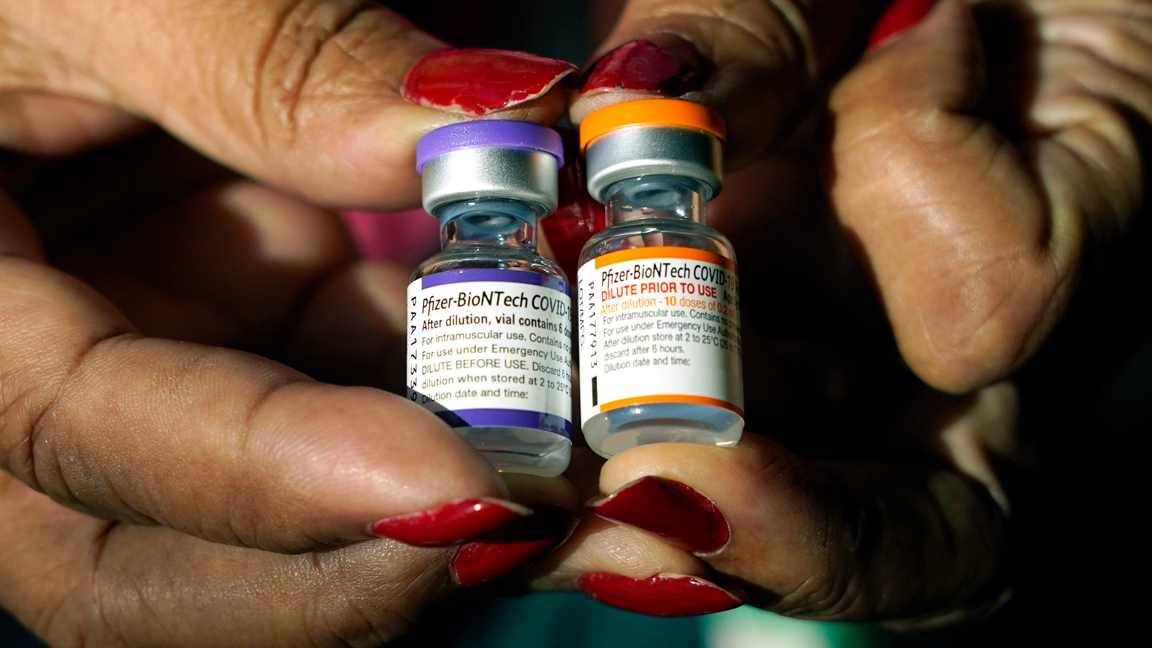 Credit: (AP Photo/Rogelio V. Solis, File)
Dr. Larry Corey, a virologist and professor of medicine at the University of Washington, supported reformulating the vaccines in a recent blog post. “This means no sickness, no breakthroughs, no hospitalizations, no complications, no anything,” he wrote. If done well, “we might be able to prevent acquisition and truly reduce the widespread dissemination of disease.”
But tweaking these shots also has downsides, according to Dr. Eddy Bresnitz, the state’s former epidemiologist who served as a health department adviser for much of the pandemic. “That modification is not a simple matter. It is simple to make the recommendation, but it’s not simple to execute,” said Bresnitz, who also worked on vaccines at Merck. There are questions about production, especially given the short timeline before fall, distribution and educating the public on the new formulations, he said. “We’re talking this is a big deal.”
‘I think the evidence is growing that this should, at a minimum, be up for consideration and study.’
While logistics should not drive the decision about reformulating the vaccines, Bresnitz said they are important considerations.
“The fact of the matter is, especially with no (additional pandemic relief) money coming from (the U.S.) Congress, I highly doubt any state is going to go back and stand up multiple mass-immunization programs. So you’re now talking about relying on the (medical) providers and pharmacies,” he said, which limits access for some residents.
Nasal spray in the works
Reformulating the Moderna and Pfizer vaccines would likely make them “even better” at keeping people out of the hospital and alive, Rodgers said. “But it’s not clear to me that the way this vaccine works is necessarily ever going to make it good at preventing the spread of COVID,” she added.
Rodgers is more interested in the development of a nasal spray form of COVID-19 vaccine, something federal scientists are working on. The hope is that changing the mechanics of delivery, as well as the formulation, could provide better protection by concentrating immunity in the nasal passages, where this virus first gains its foothold.
“I don’t feel the research establishment should buy into [the idea] we’ve solved this, and we will give you boosters of the current vaccine,” Corey told The Washington Post for a story on a nasal spray vaccine. “They led us out of the wilderness, but that doesn’t mean it has solved the problem.”
