 Credit: (NJ Spotlight News)
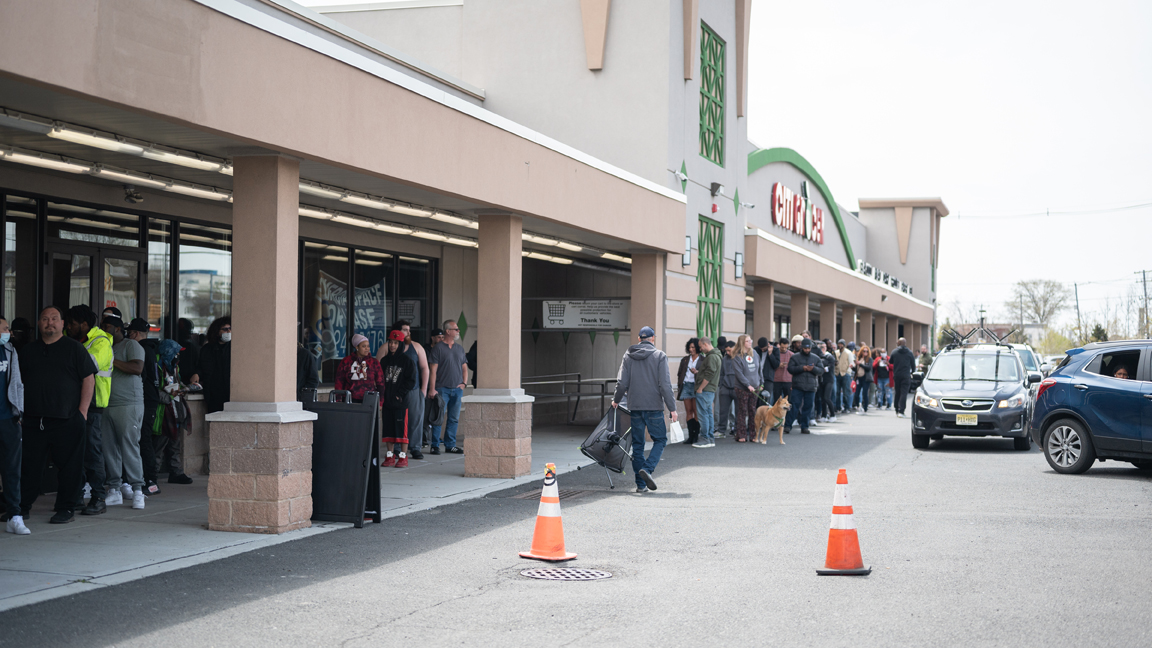
Right off busy Route 1, with cars zooming by, police directed traffic as 50 or so people stood in line at Zen Leaf in Elizabeth to buy some weed. Legally, of course.
It was surprisingly a family event, with one woman towing along her son, and with a few other “parents” bringing their furry four-legged pets on leashes and in bags.
The state announced last week that Thursday, April 21 would be the first day New Jersey would allow sales of adult-use cannabis, which is how the state refers to recreational pot, to people 21 and over. Only 13 stores were chosen to be the first to sell the legalized drug — they were already selling medical marijuana — so the state’s Cannabis Regulatory Commission warned residents to expect long lines for the first few days.
Dispensaries — not dealers
Gummies, oils, tinctures and dried flower (or bud, as pot users say) awaited customers beyond a set of frosted doors with a black metal frame. People began lining up outside Zen Leaf’s dispensary as early as 6 a.m., three hours before the store officially opened. As the line spilled over in front of a neighboring supermarket, customers seemed incredulous that they could buy weed at an official store, and not just from some guy down the street.
“How legal is this?” asked one person on the line. “Let’s test some waters.”
Others on the line also expressed that they “couldn’t believe this was happening.”
Long strange trip
The journey from residents voting to legalize pot in November 2020 to selling in stores in April 2022 has been long, and at times, drawn-out. The state insists it has taken its time to get things right. One of the state’s main concerns was that medical marijuana patients would have enough supply regardless of a rush of sales from recreational users.
Insiders say pushing the first day of sales to April 21, just one day after the infamous 4/20 pot holiday, was one of the state’s ways of safeguarding supply for medical marijuana users. But how the state came to that date has left little time to process that cannabis is now legal to buy in New Jersey, leaving doubts that it was actually happening — and that medical patients would have what they needed.
The Cannabis Regulatory Commission met on April 11 and told the 13 chosen dispensaries that they could sell recreational pot imminently — but an exact date wasn’t clear. That left little time to prepare, and dispensaries like Zen Leaf found out they’d be able to sell on Thursday along with the rest of the public last week.
In Zen Leaf’s case, executives and staff from their nationwide locations flew to New Jersey to beef up their medical marijuana operations to include adult-use cannabis. Only two of Zen Leaf’s three locations — Elizabeth and Lawrence Township — were allowed to begin recreational pot sales, with their Neptune location left out for now.
Verano Chief Operating Officer Darren Weiss, who works for the company that owns Zen Leaf, has been on-site for the past two weeks helping his stores prepare for Thursday’s sales. Medical marijuana patients would have their own shopping experience, Weiss said, with designated hours to buy their products and separate parking spaces. Patients also have the option to buy on their website or have their drugs delivered to them — something currently legal only for medical marijuana patients. Most importantly, Weiss said that Zen Leaf has enough supply for its medical patients.
“The state has done a great job providing us clarity in their rules to sell medical product that’s appropriately labeled to adult-use customers and vice versa,” he said. “And so what that enables us to do is to dedicate our entire supply to either stream.”
Recreational to left, medical to right
Weiss opened the doors to Zen Leaf to show how they also separate their recreational customers from their medical ones. Inside the opaque front doors was a concierge desk, with two employees checking government IDs to make sure customers were over 21. At that point, a person could present their medical marijuana card.
 Credit: (NJ Spotlight News)
Staff would then buzz in a customer to open another locked door, where a small lobby leads to private space for medical marijuana patients to consult with staff. Beyond another locked door is the main salesroom. Recreational users and medical marijuana patients were shunted to one side or the other, queuing up among zig-zagged barriers similar to fences at an airport’s security checkpoint.
The excitement inside the store was palpable: Staff and customers alike were smiling widely. The room buzzed with the sound of people talking; it reverberated off the hard floors and walls, just like a crowded exhibit in a marble-floored museum. No furniture or soft carpet absorbed any sound, and all cannabis products and sales associates were positioned behind a long desk, like tellers at the bank. Glass cases were scattered strategically, displaying pot paraphernalia or merchandise with the store’s logo.
And, of course, the recreational crowd on the sales floor was four times the size of the medical marijuana crowd.
Cash only
You only need two things to buy recreational pot: Cash and your government ID. Because marijuana is still illegal at the federal level, banks will not process credit card transactions.
“And that’s it,” smiled Weiss as he spoke. That’s all someone needs to buy some weed.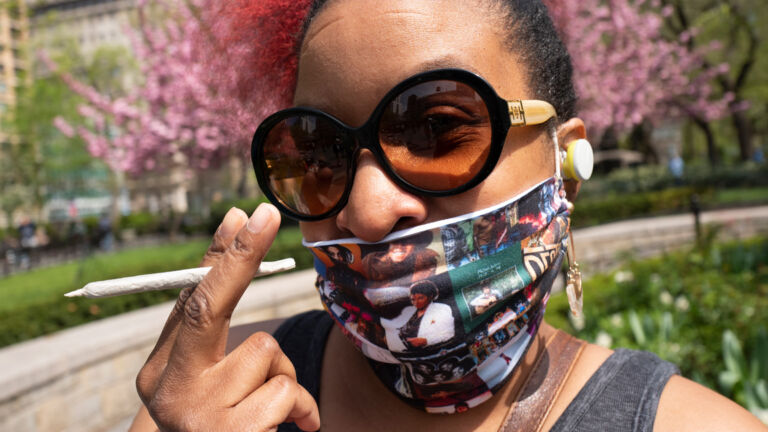
Back outside the Zen Leaf store, several customers had questions. “What are you going to buy?” was perhaps the most popular one. Although no one wanted to speak to NJ Spotlight News, one person did ask if we were taking payments to get inside — much like paying a club cover charge.
Others wondered aloud about legal questions and asked friends where they were allowed to smoke. (On private property only, if allowed.) Or how much could they buy? (One ounce of dried flower; 5 grams of concentrates, oils or resins; or 1,000 milligrams of ingestible products like gummies — which the store’s point-of-sale system tallies up. But they aren’t allowed to track who buys what.)
One man walked up to Zen Leaf executives, who were standing outside the store watching customers flow in and out all day long. “Are you sure you won’t run out?” he said. The thought of what that meant for medical patients lingered.
If that would be the case, one executive said, “There will be hell to pay.”