
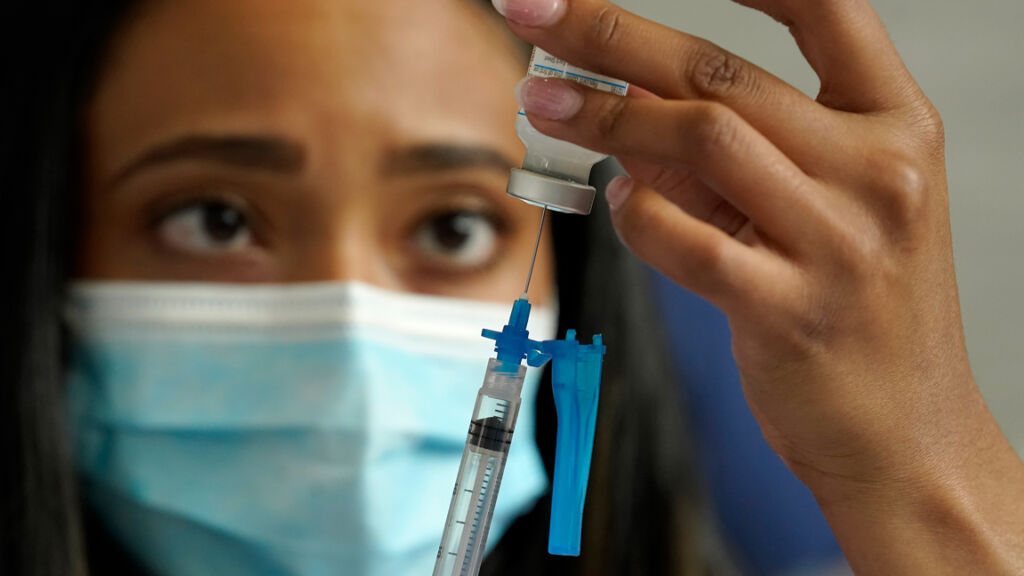
Hundreds of thousands of health care workers in New Jersey’s hospitals, nursing homes and other facilities had until Monday to be vaccinated and boosted against COVID-19 or face disciplinary action, including the possibility of losing their job. And despite an initial uproar, it seems most health care workers have complied.
More than nine out of 10 workers at health care facilities in New Jersey have completed their primary vaccine series, according to state officials, and roughly three out of four have also been boosted.
Some large hospital systems reported even higher rates: 84% of the 36,000 staff at Hackensack Meridian Health have been vaccinated and boosted, and 95% of the 38,000 workers at RWJBarnabas have met the mandate’s requirements, representatives said. Staff booster levels are as high as 99% in state psychiatric hospitals, according to the health department.
Monday’s deadline is unlikely to prompt a large exodus of staff, according to health care providers and workers, noting regional studies suggest somewhere between 1% and 2% of the workforce may be fired for refusing the shots. But experts agreed that even a small decline in bedside workforce has an impact, given the long-standing staffing shortages and the impact of recent COVID-19 surges.
‘Honestly, any staff member leaving is a big deal. Staffing is that tight. It’s our number one concern.’
“There are staff that are leaving. But it’s not a mass migration,” said James McCracken, president and CEO of LeadingAge New Jersey and Delaware, an association of nonprofit long-term care facilities. “Honestly, any staff member leaving is a big deal. Staffing is that tight. It’s our number one concern.”
Gov. Phil Murphy doubled down on the state’s existing vaccination mandate — adding a booster requirement and eliminating a testing option — on Jan. 19, just over a week after he extended the state’s public health emergency. At that time, at least 10,000 new COVID-19 cases were being diagnosed daily, and more than 5,000 people were hospitalized with the disease.
But hospitals and nursing homes balked at the timeline for compliance, which gave them until the end of February to get boosted or start the process. These worries, and changes in federal requirements, prompted Murphy to formally extend the deadline in early March, requiring compliance for health care workers by Monday.
“I’m not hearing the panicked cry from our members about the April 11 deadline,” said McCracken, whose organization represents about 50 facilities in New Jersey. “It was very loud and clear for the original deadline, ‘Hey, we just can’t do this.’”
Opposition to the mandate
The mandate itself drew sharp criticism from anti-vaccine champions on social media and was criticized by several labor unions whose leaders said they understood the important public health benefits but resented how it was forced on an already traumatized workforce.
“These last two years were basically hell,” said JNESO executive director Douglas Placa, whose union represents some 5,000 frontline workers in health care facilities in New Jersey and Pennsylvania. “And it’s just another thing they have to shoulder the burden of.”
Placa agreed that while terminations have been few, staffing levels remain “catastrophic” at nursing homes where many members work. The crisis is not limited to nursing staff, he said, with shortages of MRI technicians and other hospital staff.
“Even if you take one or two or three people away from the bedside, it still can really have a pretty detrimental effect on providing quality health care,” he said. “You just don’t have the bodies. And when one goes, the responsibility really falls on everyone else to pick up the slack. And they’re already really short.”
‘The reality is, if it’s required for your job, or to get into school, and there are no other options, the majority of the people will get vaccinated.’
While unpopular with some, the mandate for health care workers seems to have worked. However, experts note, some of its power came from the federal government’s threat to suspend Medicare and Medicaid payments to facilities at which staff members were not immunized by late February.
“The piece that makes people who are against the mandates most uncomfortable is that mandates work,” said Stephanie Silvera, an epidemiologist and public health professor at Montclair State University. “The reality is, if it’s required for your job, or to get into school, and there are no other options, the majority of the people will get vaccinated. So they work in that way.”
Overall, the state reports more than 6.8 million New Jerseyans — roughly eight in 10 of those over 5 years old — have been fully vaccinated. Some 3.3 million have also been boosted, about half of those eligible as of mid-March.
“Vaccinations help our state protect vulnerable populations from the virus. We have seen booster rates among covered entities increase since the booster requirements were issued in January,” said Christi Peace, a spokesperson for Murphy, noting that booster compliance among long-term care workers grew from 41% to more than 77% between mid-January and early April.
Limiting new COVID-19 cases
Silvera said the value of these mandates, and the rising immunization levels that result, can be seen in the way new COVID-19 case numbers have continued to remain low — even with a slight uptick recently — as a new, more transmissible variant takes hold in New Jersey. “So far, that is not translating into more hospitalization and more death and that is due in large part to the efficacy of these vaccines,” she said.
Some 2.2 million New Jerseyans have been diagnosed with COVID-19 since the pandemic began, and at least 33,000 died from the disease, state data shows. But case numbers are now six times lower than they were in mid-January, when Murphy added the booster requirement to the mandate for health care workers, and hospitalizations have declined by more than 90%.
Silvera said she is sensitive to the strain that mandates may put on health care workers, a workforce that — like teachers — has endured nearly impossible conditions during the pandemic and remains underpaid. But she said vaccinations can help reduce the stress on the health care system, which was nearly overwhelmed during the most recent surge brought on by the omicron variant, creating a more sustainable work situation for the caregivers.
‘We only have so many resources. We have to keep the COVID-19 hospitalizations down so all the other health conditions can be treated as effectively and efficiently as possible.’
“We’re talking about a system that has been really pushed to the max for two years,” Silvera said. “We only have so many resources. We have to keep the COVID-19 hospitalizations down so all the other health conditions can be treated as effectively and efficiently as possible.”
The state’s vaccination mandate for health care workers permits exemptions for medical and religious reasons, but these have been granted sparingly, according to those involved. Placa said less than 10% of his members have received such a pass; Hackensack Meridian Health has granted waivers to about 3% of workers. Murphy’s order provided employers significant flexibility in how they dealt with staff who refuse to get the shots, and there is no strict timeline for action.
Health care professionals are not the only workforce required to get COVID-19 immunizations in New Jersey, but compliance among other sectors remains more of a challenge. Murphy also required workers in congregate settings like state prisons, county jails and community group homes to be vaccinated and boosted, giving them until May 11 under the updated timeline. Public school educators and state workers also faced a mandate to get their initial shots, with a deadline in October 2021.
Initial deadline
By early March — two weeks after the initial deadline — just 43% of state corrections workers and 58% of county jail staff were fully vaccinated, officials said at the time. The state Department of Corrections said initial vaccinations are now up to 68%, and the work to encourage compliance continues; a booster rate was not available.
According to the governor’s office, between 80% and 85% of staff at group homes and day programs had received their first shots, while booster rates ranged from 42% in adult congregate settings to 57% at day programs for adults with disabilities.
The Department of Health has reported higher levels of compliance. Communications director Donna Leusner said staff booster rates at the state’s psychiatric hospitals range from 94% at both Ancora and Trenton psychiatric hospitals to 98% at the Ann Klein Forensic Center to 99% at Greystone Park Psychiatric Hospital. Among other health department staff subject to the mandate, 82% are fully in compliance, she said.
Peace said the administration continues to evaluate vaccination and testing requirements, COVID-19 rates in the community and federal guidance, including the recent recommendation that individuals over age 50 or those who are immunocompromised can get a second booster. But no decision has been made about requiring another booster for workers in health care and congregate settings or adding a booster requirement to the existing mandates for teachers or other state workers.
Silvera said she is unsure if requiring an additional booster for health care workers makes sense at this point, but she said the state — and employers — should continue to encourage those who are eligible to get that additional shot. Workplaces should also make it easy for staff to do this, permitting them time off for the vaccination and an extra day for recovery, if needed, that is not counted against their vacation or sick time.
“We don’t want to make doing the right thing burdensome,” she said.
