
 Credit: (AP Photo/Alex Brandon, File)
Going back a half-century, if not longer, New Jersey has debated what the state should demand its public high school students know and be able to do when they graduate, an argument with terms like “basic skills” and “college and career ready.”
With the pandemic still roiling and schools in an uncertain place, those terms were back on stage Wednesday as the State Board of Education held a lively and sometimes tense debate over how rigorous the state’s next high school exit exam should be.
And at least for now, the “more rigorous” camp won.
This spring, the state is to launch a new 11th grade test in language arts and math, after all graduation testing was suspending for two years amid the pandemic.
For this first test, the state board had before it a resolution from the Murphy administration to slightly lower the so-called cut score, or passing grade, due to several circumstances, including the pandemic.
But in the end Wednesday, a majority of the board’s members bucked the administration and opted to maintain the state’s previous, slightly higher cut scores. This came after state Sen. Teresa Ruiz made a rare appearance at the board’s conferences and implored the panel to keep to the higher bar.
Ruiz’s influence
“Lowering [the cut scores] … makes me cringe,” said Ruiz, the former chair of the Senate’s education committee and now the Senate’s majority leader. “I think it just lowers our standards.”
Ruiz (D-Essex) has led arguments to keep higher accountability measures to help stem the learning losses brought on by the disruption in schools in the last two years. The pandemic’s impact has been especially dire, she said, in urban districts like in her hometown of Newark.
“The last thing we want to do is set a trap for students to think they are ready to go onto college and then send them onto a freshman year … woefully unprepared,” Ruiz said, pointing to high enrollments in non-credit remedial courses in many colleges.
In what is typically a routine action with each new test, the Department of Education’s proposal specifically called for a passing score of 725 on the two sections, on a scale of 650 to 850. The state had previously required 750 on the subject tests that this new exam is replacing. The tests given in 11th grade will specifically measure proficiency through 10th grade level language arts, and Algebra I and geometry in math.
Proponents of the 725 mark said they could easily revisit the scores and the results after the tests are given for the first time, but there needed to be greater flexibility and leeway for students. They said the proposal came from working with testing and educational experts both in and outside the department to determine the appropriate mark, at least for its maiden run.
“This will give us the opportunity to start some place,” said Ronald Butcher, the board’s longest-running member, of the state’s proposal.
High or low, pros and cons
“If we go too high and then have to go to a lower number, the question is how many children did we hurt in going through that process,” he said. “We are caught between a rock and a hard place, and I think we decided to err on the side of caution.”
But Ruiz’s attendance appeared to give critics new momentum, and the discussion turned quickly. Board vice president Andrew Mulvihill has been the most outspoken for not loosening the standard, even by a little bit, and he moved to amend the resolution to put the cut score at 750 to match the previous high school tests.
The effective difference between 725 and 750 was never made clear, with one member asking if it was “statistically significant” and Mulvihill himself asking what 750 equals in more-layman grading scales. Neither got a full answer, as assistant education commissioner Gilbert Gonzalez delved into the intricacies of psychometrics and test development.
Nonetheless, the matter appeared as much one of political optics as of psychometric data, and Mulvihill and other board members said the state would be sending the wrong message if the score was lowered.
“We need to set expectations higher in this state,” Mulvihill said. “We have something like 60-70% of the kids going on to community colleges have to take remediation. We are not getting it right, and I think lowering the score is a mistake.”
‘Let’s aim higher’
He added that lowering it now to raise it later would be especially difficult. “I don’t think there will be the political will to raise it,” he said. “What, we are we going to say too many kids are graduating? I don’t think that will happen.”
The pandemic’s impact on schooling for all students was not specifically mentioned in the 90 minutes of discussion, but several board members echoed the sentiment that this was not the time to loosen standards.
Marybeth Berry, a retired special education teacher and supervisor, echoed the comments of several of her colleagues: “Yes, these are difficult times, but let’s aim higher. We have to have the best expectations for our children.”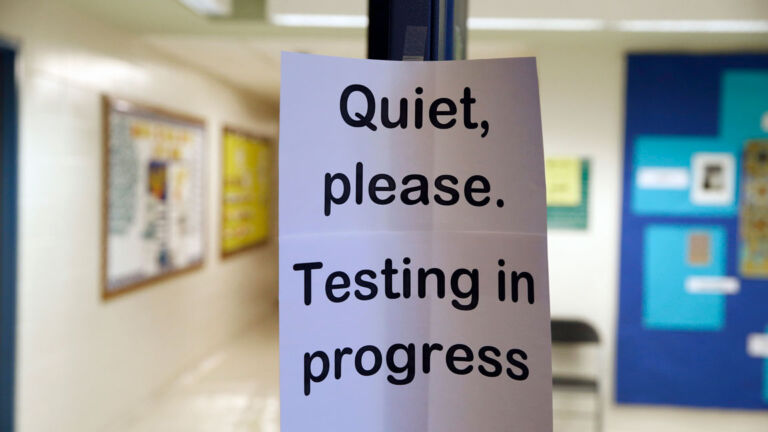
The slight discord over the issue was unusual for a board more used to decisions by consensus.
After some parliamentary haggling over motions and amendments, the vote eventually was 8-2 to put the cut scores at 750.
Yet those on both sides of this vote agreed the issue will not go away, and the first tests given this spring will be an important marker. Whatever the cut scores, preliminary testing by the state over the course of the pandemic has not fared well and foreshadowed potentially worrisome results come spring.
Time to look at different models?
In abbreviated testing given this fall in grades 3-11, the testing for 10th grade language arts found only about half of students reached that test’s mark for grade level. The passing numbers dropped well below half in Algebra 1 and geometry.
Ruiz stressed the state needs to use this opportunity to look at the bigger picture of high school tests in New Jersey and what she termed as the “super-outdated” statute from 1978 that first required the 11th grade test and remains in place.
“It still speaks to basic skills standards when we know in the state of New Jersey that what we measure are college and career-ready goals,” Ruiz said.
She said other states follow a number of different models and she called for stakeholders and officials to “roll up our sleeves” for a statewide discussion. It’s not the first time Ruiz has made the plea but indicated that her new role as Senate majority leader may provide a fresh opportunity.
“I’m hoping that next year, we are implementing an entirely different strategy,” she concluded.
