
 Credit: (TastyPoutine via wikimedia; CC-BY-SA 3.0)
Critics of a plan to expand Trenton-Mercer Airport renewed their calls on state and federal officials to examine whether contamination with so-called forever chemicals has spread from an adjoining former military base to areas where it could pollute drinking water wells or the nearby Delaware River.
Ahead of a crucial report that may come this spring from the Federal Aviation Administration — which will determine whether the project can start — campaigners from the opposition group Trenton Threatened Skies said construction might prompt the spread of the toxic PFAS chemicals, whose presence has been confirmed on the shuttered Naval Air Warfare Center that borders the airport.
The former base is now a federal Superfund site on which tests in 2016 found 15 places where two kinds of the chemicals exceeded New Jersey’s legally required health limits. Campaigners say the FAA has ignored the PFAS issue and that New Jersey’s Department of Environmental Protection has denied having any information on the chemicals at the site.
On Jan. 4, the DEP said it had no records of the presence of PFOA and PFOS — two kinds of commonly found PFAS chemicals — at several parcels of property on and around the airport. The agency was replying to an Open Records Act request by John Lewis, a Lower Makefield, Pennsylvania township supervisor from just across the Delaware River from the airport. Lewis said the DEP’s statement was “disturbing.”
Judy Hoechner, a member of the campaign group, accused the DEP of ignoring the evidence of PFAS on the base.
“It confirms that they certainly have not looked even five feet beyond the border of the airport. They aren’t looking for misuse of PFAS or migration. It’s very, very close to high levels of PFAS at the warfare center,” she said.
Superfund worries
Hoechner said PFAS-laden water from the base could flow from the Superfund site into an adjacent stream called Gold Run, and then into the Delaware River about two miles away. Critics also fear that contamination stemming from years of the Navy’s use of the chemicals in firefighting foam may spread onto the airport property.
“Airport expansion projects risk dislodging and flushing PFAS and other toxins into waterways,” she said.
Although contaminated private wells near the base were connected to public water years ago, there has been no study on how ground- and surface water could be affected by the airport expansion project, Hoechner said.
Mercer County, which owns the airport, has said the plan will result in an improved passenger terminal and a modest increase in the daily number of flights. But opponents say the project is a Trojan horse for a much greater expansion in activity at the airport, which would lead to more jet noise, worsened air pollution, and declining quality of life for nearby residents, including environmental justice communities in Trenton. A planned increase in the capacity of taxiways shows that the airport plans a bigger increase than its backers have stated, the advocates say.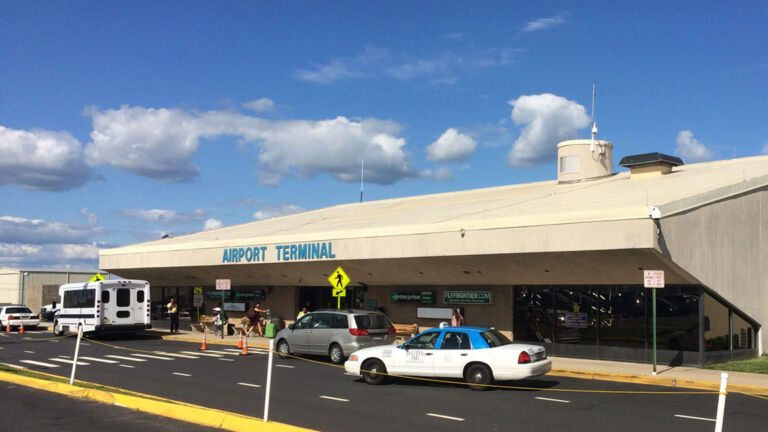
The project would result in an additional 36 takeoffs and landings a day between 2020 and 2035 among the commercial, private and military aircraft using the airport, bringing the daily total to 261 by the end of the period, according to the county. Within the total, commercial flights are expected to increase by six a day to 34.
Critics fear that if the FAA issues a finding of no significant impact in its upcoming record of decision, they will be powerless to stop the project going ahead.
If the agency gives a green light, “the public’s hands are really tied, which is why we are trying so hard to stop this FONSI ruling come out,” Hoechner said. “Once the ball starts rolling there’s nothing to stop it.”
Environmental assessment is imminent
The agency is reviewing the final version of an environmental assessment (EA), a formal probe of the project’s expected environmental impacts, which was conducted by a contractor for the county and submitted to the FAA last summer. The agency said it does not have a timeline for release but campaigners expect the document to be issued in the first few months of 2022.
“After reviewing the final EA, public comments, and applicable interagency and intergovernmental consultation, the agency will determine whether any environmental impacts analyzed in the EA are significant,” the FAA said in a statement. “The airport sponsor will publish the completed EA and signed FAA decision document once those reviews are completed.”

Many residents on both sides of the river share his concerns, Fitzpatrick said. “If this draft EA is left unchecked, I believe this project will cause substantial damage to our community for generations to come,” he wrote in a June 2021 letter.
Critics have called for the FAA to conduct an environmental impact statement — a more thorough review of a project’s environmental impacts than the environmental assessment — and argued that the DEP has the authority to require it.
Limits on DEP authority?
But DEP spokesman Larry Hajna said it has no such authority, and any decision to order an EIS rests with the FAA. For now, the DEP is considering an application by the airport authorities for a stormwater permit.
Hajna noted that Mercer County has hired a licensed site remediation professional to work on possible airport contamination, and that the Navy is working with the U.S. Army Corps of Engineers to clean up PFAS on the former base, but New Jersey “does not have Environmental Impact Statement requirements for these activities at either of these properties.”
The project has been approved by the seven Mercer County commissioners. One of them, Lucy Walter, said she was unaware of any evidence that PFAS contamination at the former Navy base had spread underground to the adjoining airport. She argued that any spread would be signaled by monitoring wells on the base.
“Those wells would be the first line of defense because they would show any kind of an increase, and to date none of those wells have shown any kind of an increase regardless of what has happened on the property,” she said.
Airport lacks facilities
Walter supports the overall expansion project mostly because it will improve the terminal building which is currently much too small for the number of passengers that use it, and lacks facilities like a restaurant or adequate bathrooms.
“Our terminal is woefully undersized,” she said. “It does not provide appropriate access or even basic amenities like bathrooms in the number that are required. Right now, when people pick up their bags, they are walking outside to a cargo container, getting their bag and then walking outside around the building. That won’t happen because there will be a space to pick up your bag inside the new terminal.”
Walter voted against a so-called runway protection zone which, if finally approved, will require the felling of some 600 trees, but she lost because the commission as a whole approved it.
Julie Wilmot, a spokeswoman for the airport, said she had “no update” on the expansion plan.

