
 Credit: (AP Photo/Seth Wenig, File)
Gov. Phil Murphy’s team remained confident it could reach an agreement Tuesday with legislative leaders to extend school mask mandates, COVID-19 vaccination or testing requirements and other pandemic protections after lawmakers declined to approve his recommendations Monday.
“This gives me no joy,” Murphy said at his weekly pandemic media briefing, “but based on the upswing of infections and hospitalizations and a couple of deaths of our precious little kids, the (school mask) mandate is going to have to stay in place for some amount of time longer.”
“We are working very cooperatively with the legislative leadership to make sure we have a good pathway forward, given the overwhelming tsunami (of COVID-19 infections) we’re dealing with,” Murphy said.
While there are some signs that the latest wave — driven by the highly transmissible omicron variant — is starting to slow, new COVID-19 diagnoses and likely cases peaked Friday and hospitalizations have quadrupled in the past month, according to state data. Health officials also reported a rise in pediatric hospitalizations and two more COVID-19-related deaths among children, for a total of ten fatalities among those under age 18.
On Jan. 1 Murphy’s attorneys sent legislative leaders a request to extend for 90 days nearly 120 pandemic-related directives, mandates or waivers issued by his office and a dozen other state agencies. The powers relate to major initiatives like Murphy’s vaccine or weekly test mandate for state workers, health care professionals and school officials; health department orders that allow testing and vaccination sites to operate; and regulatory changes allowing some state business to be conducted online, among other changes.
Blindsided by Murphy?
Legislative agendas for Monday listed several measures — including bills sponsored by outgoing Senate President Steve Sweeney (D-Gloucester), who at times clashed with Murphy, and Assembly Speaker Craig Coughlin (D-Middlesex) — designed to extend many of the government’s health care-related powers, but for just 45 days. However, lawmakers declined to vote on those extension proposals during the last day in the two-year legislative session after they said they were blindsided by Murphy’s comments on the mask mandate.
“We were not informed of (the governor’s office) taking this action today and we will not move these resolutions today,” said Sweeney during his last voting session Monday after he lost election to a little-known Republican challenger in November. Officials in Murphy’s office said the governor did not take any formal action Monday and was just expressing his expectation during the briefing.
Later, Sweeney told reporters he found Murphy’s approach “completely disrespectful” given that the governor’s comments came as lawmakers had already started their final voting session. Lawmakers negotiated what they could with the governor, Sweeney said, but were unwilling to maintain as many broad pandemic-related powers as he sought.
“It’s time to figure out how to live with [COVID-19],” Sweeney said. “We’ve been talking about different things, but we didn’t know they were making any kind of announcement.”
Oroho: ‘It’s almost like we don’t matter’
Sweeney said many Democrats shared the frustrations voiced by some of their Republican colleagues Monday, who again raised concerns about the Legislature being shut out of the governing process during the pandemic. “It’s almost like we don’t matter,” Sen. Steven Oroho (R-Sussex), the GOP leader in the Senate, said during the voting session. “We got elected to do our jobs just like the governor got elected to do his job, so let’s do it.”
Murphy’s office declined to comment on Monday’s lack of legislative action on the extensions. But while Sweeney declined to host a vote on the request, incoming Senate President Nick Scutari (D-Union) — who will take power when the new legislative session begins at noon Tuesday — may be more willing. Murphy made clear during his briefing Monday that a law he signed in June, which allowed the public health emergency to end (at least on paper) while certain emergency powers continued, gives lawmakers until 11:59 p.m. Tuesday to further extend these powers for up to three months.
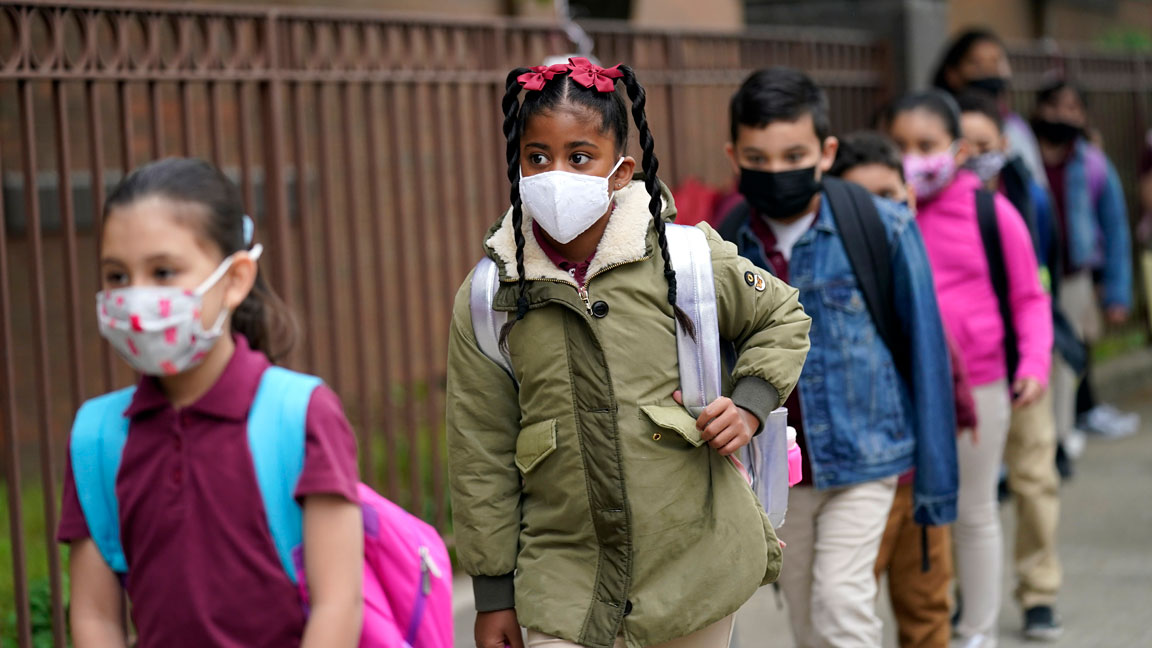
Since Murphy declared a public health emergency in March 2020, hundreds of pandemic-related orders have been issued by his office, the health department and other state agencies. It is not clear which of these could still be extended Tuesday and which could be allowed to lapse at midnight. But Murphy focused his concerns on one of the most visible — and controversial — orders, his requirement that all adults and children age 5 and up wear masks in school settings and child care facilities.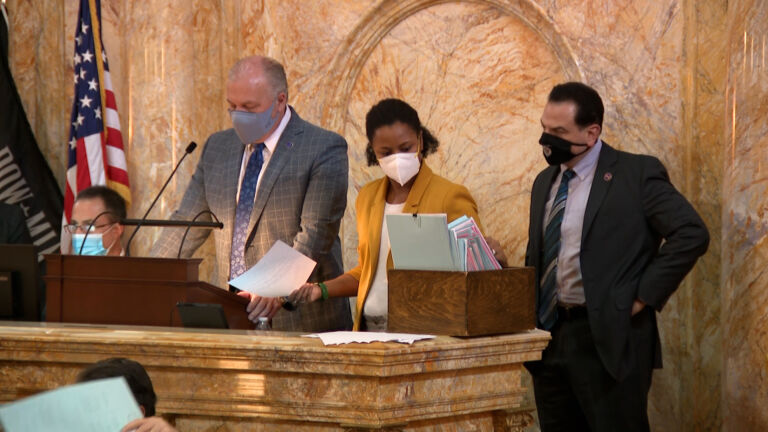
“Unequivocally, the mask mandate in school will continue for the foreseeable future,” Murphy said at the briefing. “Not forever and always, but we cannot responsibly in the teeth of this tsunami change gears on this.”
New COVID-19 cases have declined here in recent days and hospital admissions may even be starting to slow, but we remain at a high point in the omicron wave, experts note. More than 6,000 people remain in acute care facilities, the highest number recorded since late April 2020, and the latest state modeling predicts hospitalizations could continue to grow for weeks, reaching 8,000 or more patients at once. Tens of thousands of new cases will likely be diagnosed daily for the rest of the month, under the modeling.
Persichilli: ‘…we are prepared’
“We do believe we are going to have high levels for a couple of weeks,” state health commissioner Judy Persichilli said at Monday’s briefing. “But we are prepared.”
Lawmakers did approve several measures designed to ease the ongoing health care staffing shortage, which has long plagued some facilities like nursing homes. A measure sponsored by Sens. Joe Vitale (D-Middlesex), chair of the health committee, and Fred Madden (D-Gloucester) would extend until July temporary professional licenses issued to nurses, respiratory therapists, pharmacists and drug counselors, among others, which were also set to expire Tuesday. Another bill they co-sponsored would continue until 2023 certain waivers for staffing requirements related to emergency response units.
“Sustaining our state’s health care workforce and making sure our hospitals and emergency rooms remain staffed up in coming months as we continue to respond to COVID is critically important,” Vitale said in a statement. “Even before the pandemic, we were facing an imminent shortage of both physicians and nurses across the country.”
