
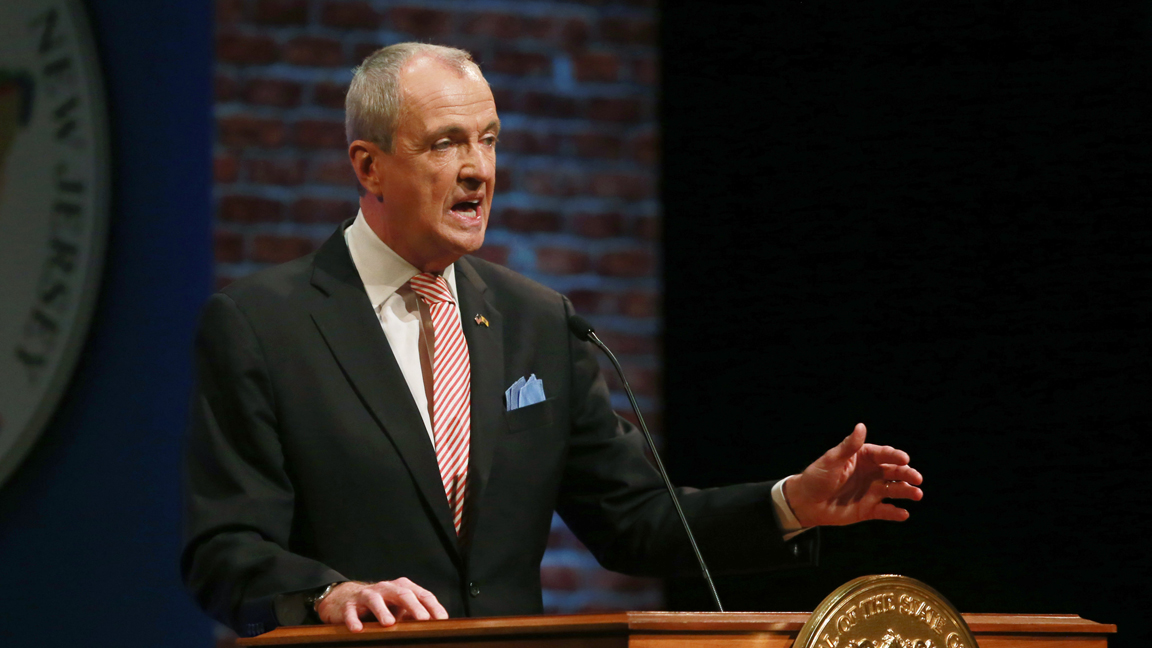
 Credit: (Ed Murray/NJ.com)
Gov. Phil Murphy talked COVID-19, the economy and more in his annual assessment of where New Jersey stands Tuesday, once again prerecorded in a concession to the deadly pandemic.
Murphy focused much of his State of the State address on his administration’s response to that public-health crisis, and he noted other accomplishments related to health care, property taxes and education funding.
But much was left unsaid Tuesday on key issues like finances, education and housing. Perhaps the biggest omission was the looming climate crisis. Murphy barely mentioned one of the more difficult issues he tackled during his initial four-year term — transitioning New Jersey’s economy from one overly reliant on fossil fuels to one powered by clean energy.
Notable omission
Murphy acknowledged the state, like the rest of the nation, is “facing an existential crisis of climate change,’’ and touted those who are finding work in the burgeoning green-energy market and at two ports serving the growing offshore-wind sector.
But he failed to mention whether his administration will step up a phase-out of fossil fuels — one of the few areas of dispute with the environmental community, which largely has been a stalwart backer of Murphy’s policies.
The issue is likely to flare again in Murphy’s second term as the administration faces decisions whether to push forward fossil-fuel projects, like a new liquefied natural gas facility in Gibbstown and a new power plant at the Passaic Valley Sewerage Commission in Newark. If the state continues adding new fossil-fuel projects, environmentalists warn the state will never achieve its goal to reduce greenhouse-gas emissions.
Health care
While focusing on COVID-19, Murphy took time to note other accomplishments related to health care. He hailed the state’s efforts to expand access to health care coverage and reduce the cost of these plans, achievements made possible by a number of reforms Murphy has led to implement elements of the federal Affordable Care Act in New Jersey. As a result, the average cost of plans sold on the now state-run exchange, or online marketplace for so-called Obamacare coverage, has grown at a far slower pace than initially predicted and participation in the program has jumped.
“So, here’s what this means — more people have insurance and they’re paying less for it,” Murphy said in the 35-minute speech.
Murphy noted this work will continue through a partnership program involving hospitals and other health care providers, health insurance companies, government officials and other stakeholders that is designed to boost transparency around medical costs and identify ways to reduce them. It also set a cap on cost growth for the coming years.
Murphy touched on some of the state’s recent actions to address the opioid epidemic, which has become increasingly deadly during the pandemic. New Jersey has greatly expanded access to naloxone, a life-saving overdose antidote and made it easier for those with addictions to obtain treatment. The state has also supported harm-reduction centers, which provide clean needles to IV-drug users and a host of other services.
“While we are proud of the progress we are making, this critical work is far from done and will continue. We continue to lose too many residents to the grip of opioid misuse,” Murphy said.
One topic not mentioned in Murphy’s speech was mental health, a growing concern for health leaders. The pandemic has caused extreme levels of anxiety, fear and grief among people of all ages and backgrounds, resulting in rising calls to crisis hotlines and pressure for more services.
‘Affordability’
Murphy won reelection in November, but his victory margin was narrower than expected. And some fellow Democrats in the Legislature lost elections that many said were decided on issues of “affordability” of life in New Jersey.
Murphy is set to be sworn in to his last term Tuesday. Ahead of that inauguration, and a budget address next month, he talked about restoring what he called responsible leadership to state finances.
Murphy did talk about taxes and finances, pledging no new tax hikes would be included in the annual budget he is due to present to lawmakers in just a few weeks for the fiscal year that begins in July.
But Murphy didn’t say that he had worked with fellow Democrats who control the Legislature to raise several taxes in 2020, and those tax increases remain in place.
Murphy and lawmakers also borrowed nearly $4 billion when they projected the coronavirus pandemic would trigger deep revenue losses. But those losses never materialized in full, and the state instead amassed a budget surplus of more than $10 billion, likely obviating the need for additional tax hikes unless spending is increased dramatically in future years or there is gross fiscal mismanagement.
And while his administration has worked to pad the state’s budget surplus and ramp up public-worker pension funding, last year Murphy and lawmakers drained the state’s “rainy day” reserve fund despite the massive budget surplus. The surplus was also used as a one-shot source of revenue to help sustain a year-over-year spending hike, raising questions about the sustainability of the budget going forward.
And despite a series of outlook revisions from rating agencies last year, New Jersey’s credit rating has not been increased, and it remains lower in the eyes of two major rating agencies today than before Murphy took office in early 2018.
Murphy highlighted his administration’s full funding of the state’s annual employer pension obligation and the savings that were achieved by reaching that benchmark a year sooner than called for under a pension-funding ramp-up schedule set by his predecessor, Republican Chris Christie. But left unaddressed was exactly how New Jersey is going to be able to maintain full pension funding for decades to come.
The state will also have to confront that challenge during a period when investment returns from pension-fund assets are projected to fall short of the record highs seen during the last fiscal year. That trend would likely put more pressure on taxpayers via the annual budget since contribution rates are fixed in law.
Education, other issues
Murphy gave a nod to public education, not saying much new but highlighting increases in state funding for schools — especially preschool — during his watch.
“Four years ago, our schools and property taxpayers were reeling after eight years of diminished investment,” Murphy said. “We got to work investing in our communities by investing in our public schools, from pre-K all the way through to graduation.
“We invested $3 billion more in our public schools across our first four years than the prior administration did across its last four. This year alone, we are investing $1.5 billion more in pre-K-through-12 education than in the year I took office.”
Still, he offered no new initiatives and passed over the huge challenges facing New Jersey schools. The Murphy administration in the next year, for instance, is expected to face two especially daunting legal challenges, one around school facilities in needy districts and another around school segregation statewide.
Murphy called the state “an unparalleled leader” in “combating senseless gun violence” and “repairing a broken criminal justice system.”
Last spring, Murphy called on lawmakers to pass a raft of gun-safety bills. Some passed one or two legislative hurdles, but none of the measures specifically dealing with guns or ammunition made it to his desk.
In his address, Murphy called for the new Legislature to pass “commonsense and comprehensive gun-safety reforms,” including a safety-education requirement for purchasers and a ban on high-caliber weapons.
Many of the criminal-justice reforms during Murphy’s first term came from the attorney general’s office. Without being specific, Murphy said the state has “started on the path of criminal justice reform” but did not specify what he would like to see happen next.
Lawmakers left a number of reforms on the table when they ended their last session, but it’s unclear whether Murphy supports all of them. For instance, the governor said he does not support giving subpoena power to all civilian complaint review boards looking into police misconduct allegations — an idea pushed by some social-justice advocates. Murphy has said he would prefer to see that power given on a case-by-case basis. Also failing to pass in his first term was a ban on chokeholds by police.
While Murphy talked about the hot housing market and blunting property-tax increases, notably absent from the speech was any reference to affordable housing, either touting accomplishments or pledging to do more this year. Murphy campaigned on the issue before his first term and ultimately stopped the practice of diverting money meant for the state fund to finance affordable units to cover general budgetary expenses.
Still there has been little news from the administration about its progress in increasing housing stock that is affordable to those with low or middle incomes despite New Jersey’s ranking among the least affordable place for renters to live.
— John Mooney, Colleen O’Dea, John Reitmeyer and Lilo H. Stainton contributed to this story.
