
 Credit: (AP Photo/Matt Rourke)
The state Senate has a new president for the first time in a dozen years and Trenton is abuzz, wondering how Nicholas Scutari, the longtime chairman of the judiciary committee, may make his mark on arguably the second-most powerful position in New Jersey.
A 53-year-old Linden resident, Scutari is best known for leading the powerful committee that considers all nominations, as well as bills related to laws and the courts. He’s also known for championing the state’s legalization of marijuana by adults, both for recreational use and for medical use.
But how will he wield his power as Senate president?
Scutari acknowledged the question during an address after taking the oath as president of the Senate last Tuesday.
‘I vow to be as bipartisan as possible’
“For the last two months, the question that I have been asked the most is, ‘Who am I and what do I stand for?‘” he said as he stood at the podium above the rest of the senators and guests. “I want to be consensus builder, working toward a balanced viewpoint that is not afraid to build on New Jersey’s policies that show progress but also balanced with the fundamentals of what our residents need in their day-to-day lives: good-paying jobs, healthy and vibrant educational settings, and an economy resurrected from the worldwide pandemic. To my friends on the Republican side, I vow to be as bipartisan as possible.”
As Senate president, Scutari now wields tremendous power. He sets the legislative agenda, deciding which bills get voted on and which never get a committee hearing. He appoints senators to committees and chooses who gets to head those committees. He gets to make a number of appointments to a host of state committees, some of them very powerful, such as the redistricting committee that redraws congressional district boundaries every decade. He also can fast-track or kill nominations made by the governor.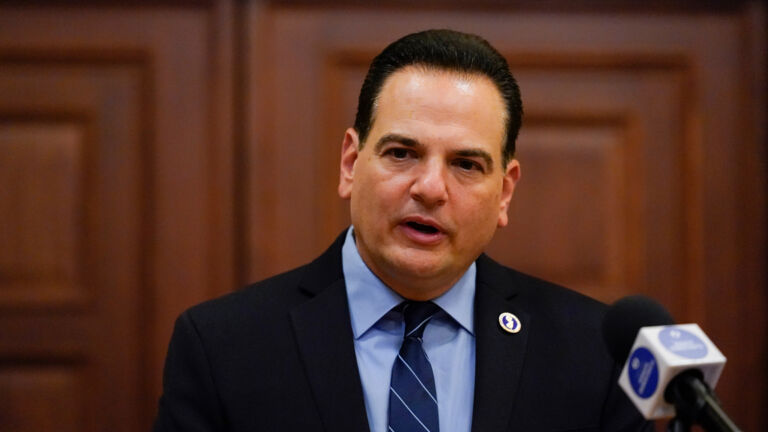
Scutari, who has also headed the Union County Democratic Committee since 2018, now controls the Senate Democratic Majority political action committee that raises and spends money to help elect Democrats: Through the third quarter of 2021, that committee had raised $784,000 and spent $442,000, according to its filing with the New Jersey Election Law Enforcement Commission.
And for now, since technically being a legislator in New Jersey is a part-time job, Scutari plans to continue both with his private law practice and as prosecutor in Carteret.
 Credit: (AP Photo/Mel Evans)
Several people who have known or worked with Scutari for years say that as chairman of the judiciary committee, he tried to fairly balance sometimes competing interests while diligently evaluating candidates for judgeships and other positions.
“He always wanted to give everyone a fair chance,” said Domenick Carmagnola, president of the New Jersey State Bar Association. “He interviewed every candidate. He worked really hard. I expect he is going to take that work ethic to his new position.”
Former Sen. Raymond Lesniak, a fellow Union County Democrat who served with Scutari for 14 years, said he thinks Scutari “has what it takes” to lead the Senate, and his oversight of nominations proved that.
“He was picked by diverse interests within the Democratic Party to lead the Senate because he showed his ability as the Senate judiciary chairman to be fair, to resolve disputes,” Lesniak said. “Disputes between Senate Democrats and Republicans over judicial appointments can be intense, and with the front office (of the governor) as well.”
‘Poor kid’ from Linden
A lawyer, Scutari said he grew up as a “a poor kid” in Linden and has lived there his entire life, except while attending law school. During his swearing-in last Tuesday, he choked up when he recalled that his mother raised him after his parents divorced and thanked her “for helping me become the man that I am today,” and when he called his father, who held the Bible as he was sworn in, “literally my best friend.” He also recalled his time at Linden High School, where he was bright, but schoolwork was not his top priority.
Scutari earned a bachelor’s degree from Kean University — then a college — in less than three years and a master’s degree from Rutgers University a year later. He was studying psychology and counseling but changed his mind and decided to become a lawyer. He got his law degree from Thomas Cooley Law School at Western Michigan University in 1993 and returned to New Jersey.While he ran judiciary committee meetings in a serious, businesslike manner, outside of official business Scutari can tell a good story. He said he might have stayed in Michigan had the county prosecutor’s office that had interviewed him not had to institute a hiring freeze. He decided to return to New Jersey “to live with my mother; I was broke.”
First run for public office
It was Scutari’s aunt who encouraged him to run for his first public office on the Linden Board of Education. He finished first in a field of six and served from 1994 to 1997, when he became a Union County commissioner — they were freeholders then — by unseating a Republican incumbent. Scutari served on the board — and was its youngest chair in 1999 when he was 31 — until joining the Senate in 2004. He joined the race in September 2003 by replacing incumbent Joseph Suliga, who bowed out after allegations he sexually harassed a woman while intoxicated at a casino.
The 22nd District that Scutari represents encompasses 11 municipalities in Union, Middlesex and Somerset counties.
He served as the majority whip in the last legislative session and on the Senate Commerce Committee and chaired both the joint space utilization committee and the judiciary committee for a dozen years. He took over the judiciary committee as former president Steve Sweeney of Gloucester County took control of the Senate. Sweeney suffered a shocking reelection loss last November to Republican Edward Durr, who benefited from high Republican turnout in South Jersey to win his first elective office.
No one had expected Sweeney to lose, and the Democratic caucus already had agreed to support him for a seventh term as speaker. After Sweeney’s loss, the party regrouped quickly. Scutari, who was as surprised as anyone at Sweeney’s loss, said he worked swiftly to gain support. Several Democratic Party leaders met with Gov. Phil Murphy and agreed Scutari would be the best person to head the Senate.
Scutari: ‘You’ve got to move quickly’
“I’ve been in this game, as they call it, for a long time and I know that sometimes these things move very quickly and you’ve got to move quick,” Scutari said. “I was happy I was able to put the pieces together to get the support of my colleagues. I didn’t know how long that was going to take … I think I had the benefit of being there for a long time and having good personal relationships with the other senators.”
“I was not surprised to see he was picked for the Senate presidency,” Carmagnola said. “You have to have relationships to get a position like that … He’s going to take the same level of energy, the same commitment to that position.”
Scutari has devoted most of his time in the Legislature to marijuana legalization. Scutari said he made that a goal soon after taking office because it didn’t make sense that alcohol was legal and marijuana wasn’t. And, as a municipal prosecutor, he saw how unevenly pot offenses were handled from town to town so that “depending upon where you got caught with this joint, you could have a really serious record” or not even be prosecuted.
“I always thought it was just ridiculous; I thought the war on drugs was just a miserable failure and I wanted to see if I could do something about it,” he said. “It’s just so hard to get people to turn on a dime. We’ve grown up in this age where you used to watch the egg on the frying pan in the commercial and it said this is your brain on drugs … No one believed that I could. But eventually people came around to the idea.”
It took 16 years.
First marijuana legislation
With so many opposed to full legalization in the mid-2000s, Scutari decided to focus first on legalizing marijuana for medicinal purposes. Though other states were moving in that direction, it proved “a really difficult challenge,” he said, and it wound up passing in the Senate by just one vote. Former Gov. Jon Corzine, a Democrat, signed the bill into law on his last day in office in January 2010. Then Chris Christie, a Republican and former U.S. attorney for New Jersey, took office and set up roadblocks that slowed the implementation of the law, which prompted Scutari to have “a couple of big, knockdown fights” with Christie. Scutari credits Murphy, the current governor, with really getting the program off the ground.
Getting the use of recreational marijuana legalized took longer and ultimately had to get approval by the voters when legislators couldn’t agree on a program themselves. Scutari even organized a trip to Colorado for a bipartisan group of lawmakers as part of his efforts but still kept coming up short.
“Eventually I came to the realization that I can’t get this done, but I could probably get people to put it on the ballot and we got that done,” he said. “And then even after that passed by two-thirds of the voters, we still couldn’t get people to vote for the enabling legislation. That took three months.”
The continued opposition by Sen. Ron Rice (D-Essex) led to a confrontation that Scutari said has been “overblown,” as well as a shouting match on the floor of the Senate that Scutari said led him to say some things he regretted because of his frustration that Rice was still opposing something Scutari had devoted so much time to and that voters had approved.
“I probably shouldn’t have said some of the things I said, and I’ve apologized more than once for it,” Scutari said. “In my defense, and I can’t defend everything I said, I had been working on this thing for over a decade and he was still trying to kill it and I was really upset about it.”
Other issues
Scutari has also led the charge on a number of other issues.
For instance, he sponsored the 2019 law permitting assisted suicide for the terminally ill; only eight other states and the District of Columbia have laws permitting physician-assisted suicide for those with only months to live. He authored another measure that year that gives an accidental disability retirement allowance to first responders disabled after assisting at the World Trade Center following the Sept. 11 attacks.
Scutari said he has also been proud of a number of consumer protection laws he sponsored, as well as reforms of drunken driving laws that included requiring everyone convicted of DWI to install an ignition interlock device to prevent them from driving after drinking alcohol.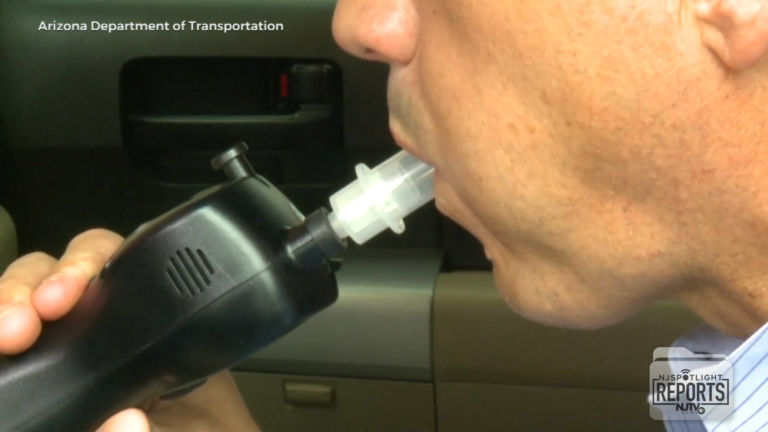
“I can tell you that, as a prosecutor, I had suspended people’s licenses for DWI and watched them walk across the street, get in the car and drive away,” Scutari said. “We weren’t doing anything. People were driving. So this was, I thought, a good way to really protect our roadways and to change people’s behavior.”
‘A lot of bad blood’
In his private law practice, Scutari focuses on personal injury and workers’ compensation cases. He has been the municipal prosecutor in Carteret since May 2019. Scutari served as the municipal prosecutor in his hometown for almost 16 years but lost that position three years ago over what he called “a lot of bad blood” between him and Mayor Derek Armstead that reached a head when Scutari became chairman of the Union County Democratic Committee almost four years ago.
Armstead said Scutari missed more than half of his court sessions in 2018 while earning an annual salary of $85,000. The city hired a law firm to review Scutari’s alleged absences between 2014 and 2018 while he was prosecutor, and it accused him of “serial absenteeism.” Scutari denied doing anything wrong and filed a defamation suit against Armstead.
“They want to hurt me,” Scutari said. “They went after me on a process that is absolutely widespread in the state of New Jersey. I got affidavits from the other prosecutors that they do exactly the same thing. And I had stellar reviews for all the years I was there, almost 16 years.”
Difference with Weinberg
Scutari came under fire last year from a colleague, then-Senate Majority Leader Loretta Weinberg (D-Bergen), who recently retired, over a domestic violence bill she said Scutari was holding up in his committee. During a meeting of a workgroup on harassment, sexual assault and misogyny that she created outside the legislative process, Weinberg said last June that Scutari once had told her that based on what he has seen as a municipal prosecutor, most cases of domestic violence are made up.
At the time, Scutari denied saying that. Last week, he told NJ Spotlight News that he and Weinberg had “had a miscommunication issue, but then we resolved it.” He said that the “minor domestic violence that you see in the lower courts” are dropped by the alleged victims “way more likely than not,” but he thinks Weinberg was more concerned about “serious domestic violence” that has been rising during the pandemic. Scutari noted that he posted the bill about which she was concerned, S-386, which would mandate domestic violence training for new municipal prosecutors. It gained final passage by the Assembly last Monday and awaits action by Murphy.
Weinberg said she thinks Scutari’s tenure as president of the Senate will be different from Sweeney’s.
“It’s going to be interesting to watch the dynamics,” she said. “I think he’s going to be very transactional. And I think he is going to be much more in tune with whatever the governor wants and more than the prior leadership was.”
Scutari said he has a “very good” relationship with Murphy, but that doesn’t mean he will advance everything the governor seeks.
Ready to work with Murphy
“I don’t know how you can’t get along with Phil Murphy, he’s one of the nicest guys in the world.” Scutari said. “We’re not going to agree on policy all the time. I hope we can agree more than not.”
One area on which they might not agree is the package of gun control measures Murphy failed to get enacted in the last session. In his State of the State message Tuesday, Murphy again called on lawmakers to pass “commonsense and comprehensive gun-safety reforms” that include banning super-high-caliber weapons.
Scutari said the state has strong gun laws and “the Constitution guarantees the right to have these guns and so I think we have to do the best that we can do to get rid of the illegal guns.”
He said he wouldn’t characterize himself, on the whole, as liberal, progressive, moderate or conservative.
“I do it issue by issue,” he said. “I can tell you in my personal life, in the office I run, we’re pretty conservative, in terms of the way in which we run the business. That’s why it’s been successful for all these years. I certainly can be deemed to be super progressive on issues like same sex marriage, marijuana usage, a woman’s right to choose. Those are things I just believe in. I don’t know if that’s progressive or not. They’re just things I think are correct.”
Some small changes already
Scutari does plan to do some things differently. He has already made some small changes, for instance, by returning Sen. Richard Codey (D-Essex) to a leadership position. Codey, the longest-serving state legislator with 48 years in Trenton and time as a former acting governor, had been on the outs with Sweeney, who replaced him as Senate president, and with South Jersey political boss George Norcross, a Sweeney ally. Last Tuesday, Scutari named Codey to the new position of vice president pro tem.
In making the announcement, Scutari called Codey “a larger-than-life figure” and thanked him “for staying with us.”
Scutari’s ascension was not universally well-received, especially against the backdrop of a political system wrestling with issues of representation and equality.
Debbie Walsh, director of the Center for American Women and Politics at Rutgers University, said it was noteworthy that when it became clear Sweeney had lost and Democrats were trying to decide on who best to replace him, the matter was decided at “a meeting of men” without any women at the table.
 Credit: (AP Photo/Matt Rourke)
Sen. Teresa Ruiz (D-Essex) was already slated to replace Weinberg as majority leader, yet she was passed over for the presidency.
“There was sort of a natural moment of saying, we had her slotted to be the majority leader, why not make her the Senate president?” Walsh said. “And when you think about the Democratic Party and the message that it wants to send out into the world, a woman, a Latina, would have been a powerful image for the Democratic Party. But no. We live in New Jersey.”
Patricia Campos Medina, a Latina activist who is executive director of The Worker Institute at ILR-Cornell University, said she was personally “disappointed” in Scutari’s elevation to the presidency given the allegations raised by the Linden mayor about Scutari missing so many days in court as the city prosecutor and Weinberg’s statement about the comments he made about domestic violence.
“I don’t think he was the best choice for the senators to show they were actually listening to women’s concerns and to all voters’ concerns,” she said. “It just shows the lack of regard that they have for appearances. It’s not just about race and representation, but it’s also about ethical issues.”
