

Editor’s Note: Pet Projects, Public Cash from NJ Spotlight News details how New Jersey lawmakers direct millions to projects, often with little public scrutiny over how that money is spent. Today’s stories focus on how much lawmakers themselves tuck into state budget and just what is pork spending. Coming Tuesday: Few rules detail what lawmakers can ask to spend, and many don’t follow them.
Adding pet projects to a budget is not unique to New Jersey. It happens in many, if not all, states. At the federal level, these projects are called earmarks or “pork.” In Trenton, “Christmas tree” is the phrase of choice.
Basically, budget pork is money given to one town, county or organization outside of the usual government grant programs or processes. Some pork is easy to spot: $50,000 to the Count Basie Center for the Arts in Red Bank, $250,000 to Belleville for “Acquisition of Property” that a Senate document deemed historic. Both items were added to the current budget by lawmakers who represent those towns.
But labeling other added spending items as pork is not so clear-cut.
 Credit: (NJ Spotlight News)
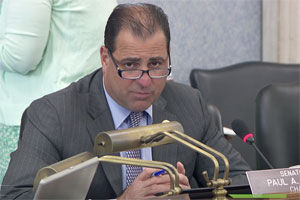
“There’s no such thing as pork in a budget,” commented Sen. Paul Sarlo (D-Bergen), chair of the Senate Budget and Appropriations Committee, shortly after the budget passed the upper house at the end of last June. “What you consider to be pork … may not be considered pork to that county or that advocacy group.”
In some years, the spending has been tempered by the governor’s line-item veto. One year, Republican Chris Christie’s red pen so incensed Sen. President Steve Sweeney (D-Gloucester) that Sweeney called Christie a “prick.” In his first two years in office, as relations with legislative leaders — Sweeney in particular — were strained, Gov. Phil Murphy vetoed some $235 million in spending that Democrats had sought to tack onto his budget proposals. Murphy and Democratic lawmakers have a much better rapport today: In the past two budgets, Murphy did not eliminate any of their spending additions.
In some years, spending on pet projects is out of favor with the public. But in the most recent election year, it became something for legislators — especially those in tough races — to brag about.
Timing is everything
Micah Rasmussen, director of the Rebovich Institute for New Jersey Politics at Rider University, said lawmakers were taking more credit for budget additions last summer because there was enough funding to go around this time,” compared with other years.
“Certainly not every initiative wound up being fully funded, but enough did that there wasn’t an imperative to keep your success quiet because not every member of your caucus did as well as you did. “Timing has a lot to do with it as well,’ said Rasmussen, who added that from start to finish,” the current budget was an election-year budget.
But how do pet projects become part of the budget? Lawmakers submit changes to the governor’s budget proposal by offering resolutions. That makes the request for added spending transparent to the public, because it gives people an easy way to see legislative changes, lawmakers and staff say. The alternative, they argue, would be to take the legislative budget bill and compare it with the governor’s proposal, going line by line through the documents, each of which runs to hundreds of pages. That would be time consuming, given the state has spent or promised to spend close to $3 billion through these resolutions since July 1, 2017.
“It is the Legislature’s responsibility to revise and enhance the governor’s proposed budget, which was accomplished … with months of public hearings and input as we worked to respond to the fiscal uncertainty of the most challenging public health crisis of our time,” said Richard McGrath, a spokesman for the Senate Democrats’ office. “Budget resolutions are part of this process. They allow the Legislature and the administration to identify specific needs and make needed changes.”
New Jersey’s use of budget resolutions came as a reform that grew out of the mid-2000s, when an opaque budget process helped foster public-corruption scandals that led to the convictions of two sitting senators.
Names on the line
Those scandals led legislative leaders to change the process in 2007, requiring lawmakers to put their names on requests — literally signing them, although that no longer appears to be the case — and indicating any potential conflict of interest. The first year Sen. Richard Codey (D-Essex), then the president of the Senate, put this system in place, the resolutions had to be submitted at least 21 days before the Legislature’s budget votes and were made public 14 days before final passage. The rules no longer apply.
“Those reforms that we put in were good,” said Codey, the state’s longest-serving legislator, who was also acting governor. Codey said he thought it “reasonable” to require lawmakers to publicly sponsor the resolutions and post them two weeks before a vote. “I don’t know what happened to them after I was (Senate) president.”
The rule states: “The sponsor or sponsors of a budget resolution shall set forth in detail therein each revenue, line-item or language provision proposed to be added, deleted or changed and append thereto a statement explaining the proposed changes and the reasons therefor.”
Soon after the process was adopted, legislators had to explain the rationale for a proposed change and include contact information for a nongovernment entity that would get money, when applicable. But the current form has been pared down, with those detailed questions removed.
According to an NJ Spotlight News analysis of some 1,200 budget resolutions — approved and rejected — submitted by lawmakers during the 2018-2022 fiscal year budget cycles, the specifics in the actual requests filed by individual legislators varied significantly.
Some resolutions do not specify the cost of the requested item. On other requests, the amount listed in the summary does not match the amount stated in the body of the request.
Some of the requests appear to circumvent existing grants for which organizations can apply, although that is not always clear from their descriptions.
For example, the current budget includes $80,000 for security improvements for the Bris Avrohom center in Hillside. The state Office of Homeland Security and Preparedness already has a nonprofit security grant program to which the center could apply. There’s $300,000 for a Paramus library addition, even though money remains available from a $125 million library construction bond approved in 2017. And Sen. Nilsa Cruz-Perez (D-Camden) sponsored resolutions giving the Camden County Improvement Authority a total of $30 million in 2020 and 2021 for “demolition of vacant property,” although there already is Small Cities Community Development Block Grant funding to demolish unsafe structures.
The way DC does it
For the past decade, earmarks in the federal budget were technically banned, though some reports have found that the most powerful and senior federal lawmakers were still able to get their priorities into omnibus spending legislation. The House of Representatives brought them back last year as “community project funding requests,” but with limits on the number that representatives could request, and requirements that members post their requests on their own websites and on a central webpage.
All the requests for the 2022 federal budget, as well as lists of funded requests and the letters written by members of Congress explaining what the money will pay for and including a notation that the representative has no financial interest in the recipient were available online well before the final votes.
In contrast, the resolutions submitted by New Jersey lawmakers typically are not posted on the nonpartisan Office of Legislative Services website until well after the governor has signed the budget, sometimes almost a year later.
