
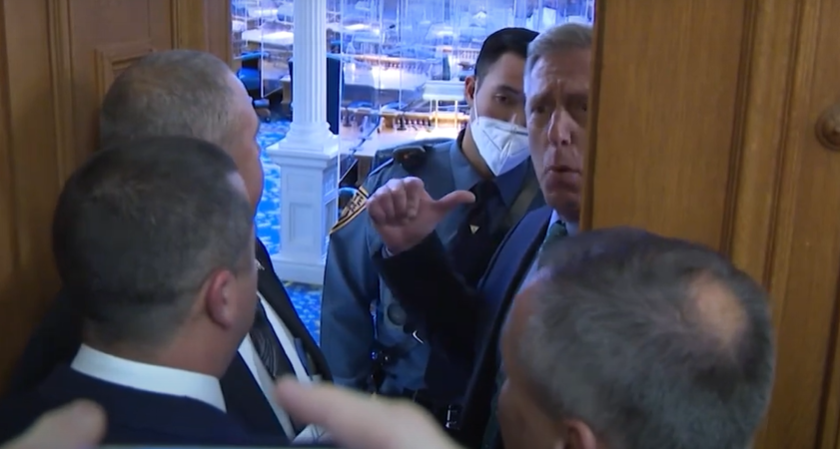
Despite a delayed start — prompted largely by loud Republican defiance of a new COVID-19 mandate at the State House— New Jersey lawmakers eventually got down to the work of lame duck on Thursday, albeit with some GOP members missing.
In the Senate — led by outgoing Senate President Steve Sweeney (D-Gloucester), who lost to a largely unknown Republican earlier this month — lawmakers efficiently dispatched dozens of legislative proposals. Despite the political overtones, lawmakers of both parties joined forces to support a number of initiatives, including a bill to drastically expand access to state tax credits for child care, which could benefit 80,000 families.
While the Assembly was delayed for nearly three hours, and several Republican members participated by phone, the agenda was edited down and the entire session lasted less than 20 minutes.
Speaker Craig Coughlin (D-Middlesex) decried the GOP’s resistance to the State House vaccine mandate, which includes a testing option, and blamed them for putting politics before the people.
“Today 80,000 families earning up to $150,000 received a tax credit and thousands of hardworking poll workers got a raise despite the fact that a small group of radical Assembly Republicans chose to put showmanship for their own gain above the interests of the working people of our state. Democrats came down to do the people’s business, complying with a reasonable common sense policy that millions of New Jerseyans follow each and every day, and we addressed the most pressing legislative matters,” Coughlin said.
Before today’s session began, several GOP Assembly members refused to provide proof of either full vaccination or a negative COVID-19 test to State Police standing at the door of the chamber, as required under the mandate.
And yesterday, Republicans challenged the mandate in court, saying the policy imposed by Democrats via the State Capital commission unfairly restricts the public’s access and is unconstitutional because the commission lacks authority over legislators.
The Democratic leaders did pull several notable measures from the agenda. The Assembly held off on voting on a proposal to require the state Economic Development Authority to create a loan program to help municipalities upgrade from diesel to electric buses. And the Senate postponed action on a bill that would provide $25 million in federal COVID-19 relief funding to the state’s tourism industry, which was hard hit by the pandemic.
Highlights from votes that did occur
Child care (S-4065) – a bill to revise the state child- and dependent-care tax credit, which would more than double the salary cap that determines participation, passed both houses with unanimous support. Under the plan, New Jerseyans who earn up to $150,000 could receive a credit on their state income tax for a percentage of the federal tax credit they receive for these expenses.
Election pay (A-1527) – The Assembly voted 77-0 to raise the pay for election workers from $200 a day to $300 in a bipartisan bill that would also appropriate $7 million in state funds to cover the added cost. Counties around the state face a growing struggle to recruit poll workers and supporters hope more money will make that easier. The measure now returns to the Senate for final approval.
Dry needling (S-867) – The Senate voted 29-3 in favor of a controversial measure to allow physical therapists to once again provide dry needling, a form of acupuncture used to unlock muscle spasms. Acupuncturists have opposed the bill, expressing concerns about safety. Physical therapists had provided the service but the state attorney general halted that practice in 2017. The measure passed the upper house with no debate; the Assembly has yet to hold a hearing on the bill.
Telemedicine (S-2559) – Senators voted 35-0 to accept changes proposed by Gov. Phil Murphy to a measure they had passed earlier in the year that would have set telehealth reimbursement rates on par with payments for in-person visits. Murphy called for parity to remain in place for a few years while state health officials study the issue and recommend a payment structure. The changes must still be approved by the full Assembly.
Infrastructure bank (S-4078, S-4079) – The Senate voted on a handful of measures to expand access to state funding for infrastructure projects, including a pair of bipartisan bills that will allow at least 200 green-infrastructure projects to qualify in 2022. Lawmakers said it would allow for much-needed investment in protecting clean water — including drinking-water sources — and restoration projects that date back to Hurricane Sandy. Both houses voted unanimously to approve these two bills Thursday, sending them to the governor to be signed into law.
