
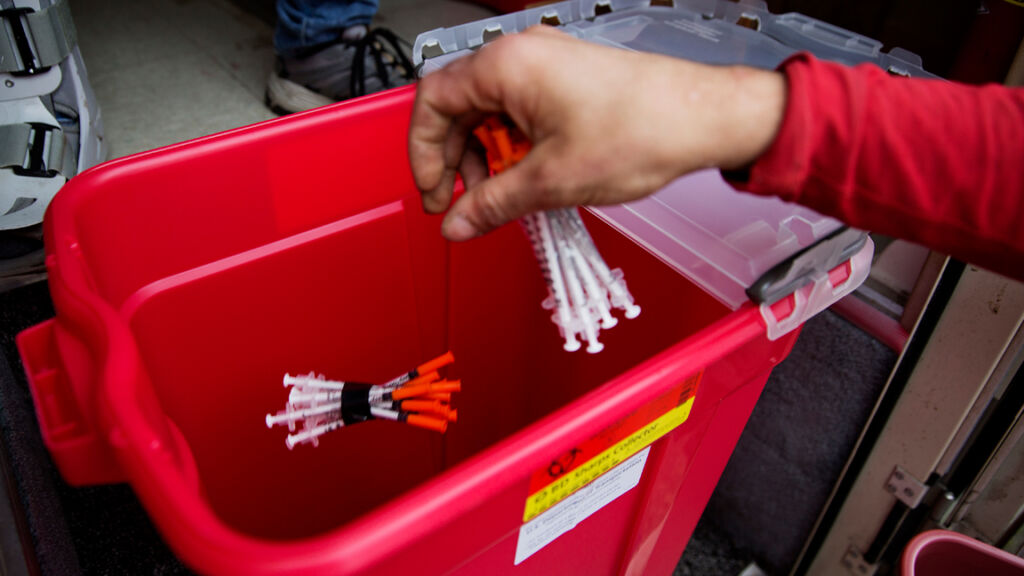
New Jersey lawmakers are pressing forward to expand access to clean-needle programs for opioid users — and reduce blood-borne infections like HIV/AIDS — including one bill that would give the state, not local government, more control over where to locate programs.
Monday’s votes before the Assembly health committee came just days after a state Superior Court judge continued to block an effort by Atlantic City to close a syringe-access, or harm-reduction, program located not far from the boardwalk. Local officials have raised concerns about dirty needles and crime, while harm-reduction advocates say the facility is essential to public health, given Atlantic City’s high rate of HIV.
‘Research has shown time and again that harm reduction measures work.’
“Research has shown time and again that harm reduction measures work,” said state Assemblywoman Valerie Vainieri Huttle (D-Bergen), a lead sponsor of the harm-reduction bills. Access to clean needles has been associated with a 50% decline in HIV and hepatitis C, a decrease in overdose deaths and an increase in treatment acceptance, the legislation notes.
“People struggling with addiction will often find a way to obtain and use drugs regardless of the potential risks,” Vainieri Huttle continued. “We must do everything we can to support and expand these services to reach all of our communities.”
Harm-reduction centers
There are currently seven harm-reduction centers in New Jersey, including the Atlantic City site, which offer intravenous drug users clean needles, cancer screenings, wound care, overdose-reversal kits and referrals to treatment for addiction, mental health issues and social services. But under the current law, adopted in 2006, municipalities must proactively seek to open a program, and NIMBY-ism — “not in my backyard” — has resulted in a limited number of facilities, only in urban communities.
The bill (A-4847) approved Monday by the Assembly Health committee would essentially flip this script, empowering health care facilities or nonprofit organizations to ask the state permission to open a harm-reduction program in any community. If their application meets the requirements in the 2006 law, the state health commissioner would be required to approve it and work with local clinical providers, social service agencies and municipal officials to try to build support for the initiative. Under the proposal, the commissioner is the only one who could shut down an existing program.
The Assembly Judiciary committee approved a separate bill (A-5458) that would decriminalize the possession of syringes, something that advocates said resulted in some 55,000 arrests since 2012. The proposal, which is widely supported by public health experts, would also expunge past criminal cases related to needle possession.
‘Decriminalization of syringes and expanded access would mean that it’s safe … for someone to tell a law enforcement officer or EMS provider that they have a syringe on them.’
“Expanding harm reduction services in New Jersey is urgent,” said Caitlin O’Neill, a director at the New Jersey Harm Reduction Coalition. “Decriminalization of syringes and expanded access would mean that it’s safe to ask a doctor about safer injecting practice to avoid life threatening skin infections and endocarditis, safe to even say out loud that you need help to stop injecting,” she explained, “and safe for someone to tell a law enforcement officer or EMS provider that they have a syringe on them, drastically lowering the risk of needle stick injury among first responders.”
COVID-19’s impact on substance use
Legislative sponsors and harm-reduction advocates stress that the pandemic has expanded the need for these services, with the fear, stress and isolation associated with COVID-19 driving more people to use drugs and alcohol. The bill cites federal data from June 2020 that notes a 13% uptick in new or increased substance use since the start of the pandemic in March that year.
Overdose deaths were on the rise for more than a decade in New Jersey before they appeared to peak in 2018, when some 3,118 residents lost their lives to an excess of opiates or other drugs. They declined slightly in 2019, but then began to tick up again and — based on numbers from the first half of the year — and are now on track to surpass the 2020 total of 3,046, according to state data.
The bill to revise how harm-reduction centers are created — which also appropriates $5 million for these programs and $10 million for treatment efforts — was approved by the Senate health committee earlier this year, but now faces a review by members of the budget committee. The proposal to decriminalize syringes was already approved by the full Senate in June, along a party-line vote with Democrats largely in support. A third measure, which expanded access to an opioid-overdose antidote called naloxone, was signed into law in June.
