
 Credit: (James Loesch from Flickr; CC BY 2.0)
New Jersey is providing $45 million in new low-interest loans to repair and upgrade dams to ensure their safety and help them cope with increased flooding caused by climate change.
The Department of Environmental Protection is making $40 million available through a state program on dam restoration, and another $5 million through the Inland Waters Loan Program which funds flood-mitigation projects such as dredging and stream restoration.
DEP Commissioner Shawn LaTourette said the new funding is part of the state’s plan to become more resilient to the effects of climate change.
“This funding will enable private and municipal dam owners to undertake environmental infrastructure projects that provide more spillway capacity that is critical to public safety, especially as rainfall events continue to become more severe due to our changing climate,” he said in a statement Monday.
The DEP last provided loans for dam repair in 2017, said Larry Hajna, a spokesman for the department. He said the funding is not a direct response to the historic flooding brought by Tropical Storm Ida in early September but will help owners ensure that dams are safe in the face of higher flood risk from climate change. There were no dam failures during Ida, the DEP said.
Why it makes sense to remove some dams
If they are not specifically built for flood control, dams can worsen flooding by forcing water to back up behind their walls and spread across adjacent land. It can be appropriate to remove those dams rather than repairing them, although some have historic or recreational value and so will be left in place.
Some dams such as those on the Musconetcong River in northwestern New Jersey have been removed over the last decade to allow the passage of migratory fish to their historic spawning grounds for the first time since settlers built dams to power mills starting in the 18th century.
Dam owners may seek loans to cover the cost of removal if dams are no longer needed, the DEP said. Over the past 15 years, 35 dams have been removed, and the DEP said it has partnered with various groups to remove obsolete dams for fish spawning where possible.
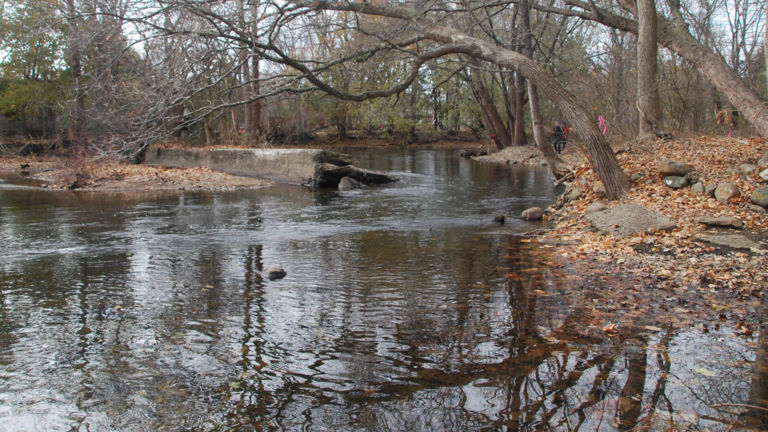
A possible use for the new funding would be to modify dams so that their ecological effects are better than those of the current structures, Hunt said. For example, a dam that spills water over its top during the summer results in warm water flowing into the lower part of the river, creating conditions there that are not favorable to cold-water fish like trout.
By contrast, the release of water from the bottom of a dam — if it was part of a remediation program — would result in colder water coming out into the lower river, creating more favorable conditions for some species.
Restore some natural functions?
“Maybe this is an opportunity for some publicly owned dams to be modified in such a way to restore some of the natural functions around the dam,” Hunt said, referring to the new funding.
To qualify, a project must be undertaken by a county or municipal government or related agency. Projects by private dam owners are required to have a county or municipal government agree to be a co-applicant. The application deadline is Dec. 30.
The funding is available for dams that are deemed by the DEP to be in “fair” condition — meaning that they have minor deficiencies that require remedial action — or “poor,” when remedial work is needed and further study is required to identify the extent of the problems.
The DEP has a three-tier system for identifying the hazards posed by structurally flawed dams; the worst is Class 1, which anticipates a loss of life and/or extensive property damage if the dam fails.
Dams in the “high” and “significant” hazard categories are required to be inspected every two years — or annually for larger dams — and measures taken to improve their safety. Remedial work usually means modifying the spillway and strengthening surrounding banks to make sure they don’t collapse if the dam overflows.
The DEP said there are 177 “significant” and “high” hazard dams rated as having “poor” safety conditions, indicating that remedial work is needed. Another 80 dams are in “fair” condition, indicating they may need repairs or upgrades.
Whether dams are repaired or removed, the judgment must be made in each case, depending on a range of environmental, historical or recreational factors; whether it’s used for drinking water supply, or whether public safety is at risk, Hunt said.
“Public safety is top of mind here,” he said.
