
 Credit: (Edwin J. Torres/NJ Governor’s Office; CC BY-NC 2.0)
When Phil Murphy ran for governor four years ago, he promised bold changes in energy policy.
By and large he delivered, overseeing a dramatic shift in policies as significant as in any other area of state government in recent years.
In four years of his first term, Murphy, a Democrat now seeking reelection, revived a dormant offshore wind program. His administration restructured New Jersey’s successful but expensive solar program. And a revamped Energy Master Plan details a credible blueprint toward achieving 100% clean energy by 2050.
NJ Spotlight News is taking a closer look at some of the ways Murphy has sought to address New Jersey’s many challenges. Today’s installment looks at Murphy’s green energy programs. In other installments, we examine his record on public education, the state budget, taxes, the environment, health care and COVID-19.
Other actions by Murphy have led, or eventually could result, in new efforts to decarbonize the aging electric grid. Just this past Friday, the New Jersey Board of Public Utilities announced a new initiative to explore how to modernize the power grid to accommodate increased reliance on renewable energy.
Even so, with increasing extreme weather events signaling that climate change is already wreaking havoc, some activists say the state is not moving fast enough, a premise even Murphy agreed with this fall. Other critics say the administration, despite some successes in blocking a couple of new natural gas pipelines, needs to accelerate the phaseout of the state’s reliance on natural gas.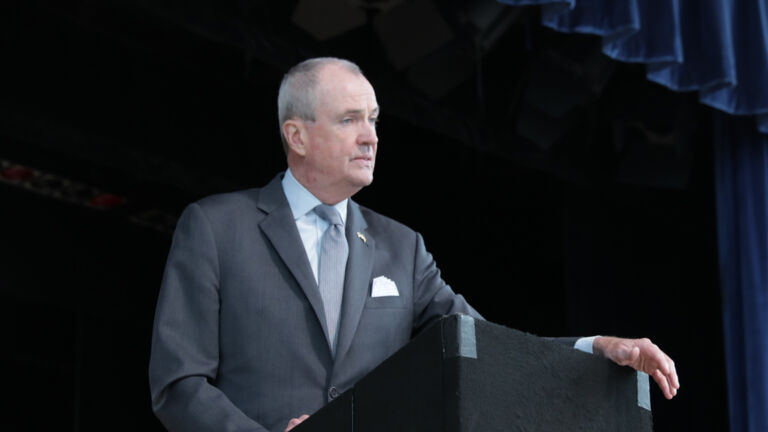
Still others, while applauding the transition to cleaner ways of producing electricity — like offshore wind and solar energy — question why the Murphy administration refuses to tell the public what it will end up costing, fearing the transition will usher in steep costs in energy bills. Murphy dodged the question in the second gubernatorial debate last week.
What’s it going to cost?
Initially promised as part of the Energy Master Plan, a release of any cost projections has been repeatedly delayed by the administration, most recently this past spring when it decided to hire a consultant to assess what the transition will cost, a process now expected to take 18 months. Critics argue it is important to know the cost so the state can choose the most cost-effective clean-energy strategies.
More than anything else, however, it is Murphy’s ambitious push to create a cleaner and greener New Jersey that is likely to be his legacy, win or lose next month, as he seeks a second term.
Here is a breakdown of how Murphy has responded to events and issues during his term as chief executive, this time focusing on the environment and energy.
Clean energy: New Jersey has emerged as a national leader in offshore wind development, approving three separate projects off the Atlantic coast that could lead to wind turbines producing 3,768 megawatts of clean-energy capacity, enough to power 1.6 million homes. In addition, the state has lured offshore wind manufacturers to the New Jersey Wind Port in Salem County and the refurbished port in Paulsboro, steps that could foster a robust industry to power a green economy with the potential of creating thousands of new jobs.
The offshore wind and solar industries are now projected to provide 27% and 34% respectively of the state’s electricity by mid-century, according to the Murphy administration’s projections. The state also has overhauled its efforts to reduce gas and electric use, mandating utilities enact programs to help customers curb their consumption.
Elsewhere, however, it has failed to achieve some of its clean-energy goals.
The administration has established programs to encourage motorists to switch to electric vehicles, a step that could clean up New Jersey’s often unhealthy air while at the same time reducing emissions from vehicles contributing to climate change. Today, more than 40,000 electric vehicles are on the road, but far short of the state’s goal of having 330,000 zero-emission vehicles on the road by the end of 2025.
New Jersey also is well short of another clean-energy target for energy storage, a technology deemed critical to dealing with the intermittency problems associated with solar and wind power. By the end of this year, the state was supposed to develop 600 MW of energy storage; it now has less than 100 MW.
Raids on clean-energy funds: As a candidate, Murphy pledged to end raids on a clean-energy fund. In the past, former Gov. Chris Christie and legislators repeatedly siphoned off more than $1 billion from a special fund supported by a surcharge on customers’ utility bills. Murphy vowed to end the diversions and did curtail how much money was diverted, but still allocated $82 million to help NJ Transit pay its energy bills in the current budget.
Water quality: Others credit Murphy with expanding protections for so-called Category-1 streams, the most pristine waterways in New Jersey. The designation of C-1 aims to ensure those 749 miles of rivers and streams do not suffer any degradation in water quality.
Much to the dismay of some environmentalists, though, the state Department of Environmental Protection has not repealed regulations adopted during Christie’s term that overhauled, and, according to critics, weakened rules dealing with flood plains.
Dealing with pollution: Murphy championed and signed a far-reaching bill that is designed to help environmental justice communities, typically urban and mostly minority areas where residents suffer from increased pollution burdens. The legislation, billed as the nation’s strongest environmental justice bill, gives those communities more tools to block new projects that could increase pollution in those areas.
Meanwhile, DEP is drafting new regulations aimed at reducing emissions contributing to climate change from power plants, trucks, industrial boilers, and at ports to help achieve an 80% reduction in climate pollution below 2006 levels by mid-century.

