
 Credit: (AP Photo/Carlos Gonzalez)
New Jersey’s top environmental official says the state will expand its program that buys private properties in flood-prone areas after the devastation caused by Ida, but warned that any plan to move whole communities out of harm’s way is beyond the state’s means, and would require federal help.
Shawn LaTourette, commissioner of the Department of Environmental Protection, said the state now has the money to buy some additional properties, and will do so, thanks to the Legislature’s decision in 2019 to dedicate more revenue to the so-called Blue Acres program from the Corporation Business Tax.
“The program definitely needs expansion,” he said during a conference call with reporters Tuesday. “Now we have that greater ability, and we’ll be making use of that, no question.”
But any purchase of whole communities would depend on more funding from the federal government, which he said could indeed be coming from Washington.
“I would be surprised if we didn’t see that come through in any kind of disaster legislation pending in Congress,” he said.
At Tuesday’s conference on environmental policy in the wake of Ida, LaTourette faced a series of questions about the future of Blue Acres after severe flooding in many communities — such as those along the Rahway River — left many with ruined homes and millions of dollars in damage.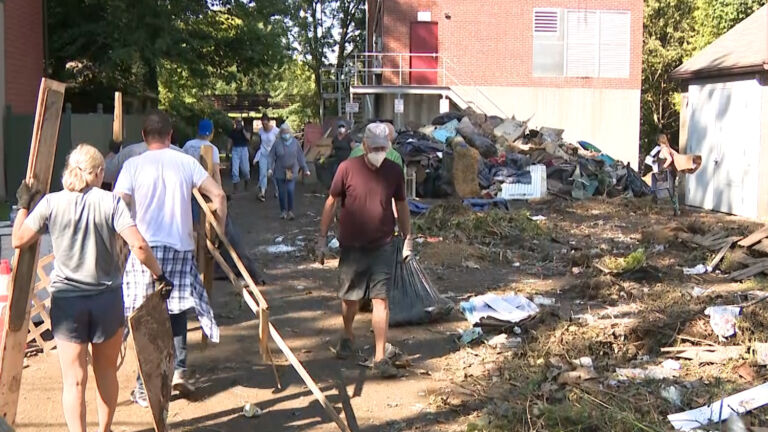
Blue Acres began in the 1990s but sharply expanded after Superstorm Sandy in October 2012. Since May 2013, the program has made offers on 1,126 homes in 20 towns — 830 of them accepted by the owners — spending more than $200 million, according to DEP data. Purchased homes are demolished, and their land is converted to open space which becomes a buffer for coastal or riverside flooding.
The voluntary program has seen a surge in interest in the wake of Ida after waning as years passed after Sandy, LaTourette said. He attributed the earlier decline to fading memories, which were dramatically refreshed by the latest monster storm, with its record rainfall, tornadoes, and more than two dozen deaths across the state.
Environmentalists have said Blue Acres is a step in the right direction but cannot match the scale of climate change that fuels storms like Ida and is forecast to add several feet to sea levels at the Jersey Shore this century.
“Sandy was a benchmark storm, and Ida too is a benchmark storm but on the flip side, on the side of fluvial, riverine flooding,” LaTourette said.
Mandatory buyouts?
Despite new interest in the program, LaTourette ruled out any mandatory buyouts, saying no legal authority now exists to allow the state to make a compulsory purchase of private property.
“Unless there were a new statutory authorization of identified areas that cannot be utilized for residential development, say, there is not a mechanism for doing that,” he said, after being asked whether the state was considering mandatory buyouts.
His comments follow remarks by a planner at the U.S. Army Corps of Engineers on Monday raising the prospect that mandatory buyouts may be a topic for discussion between state and federal governments.
“We need to also look at relocation and acquisition,” said Jay Smith, project manager for the Corps’ massive New Jersey Back Bays Study, which has proposed building storm-surge and cross-bay barriers at five vulnerable sites at a cost of $16 billion.
“The devil is in the details when you compare the federal program with the state program,” Smith said, during an online event to hear public comments on the latest version of the federal plan. “It has to do with mandatory versus voluntary buyouts and the use of eminent domain to do that, which may not be a popular topic but that is something that we need to sweat with the state and our partners going forward.”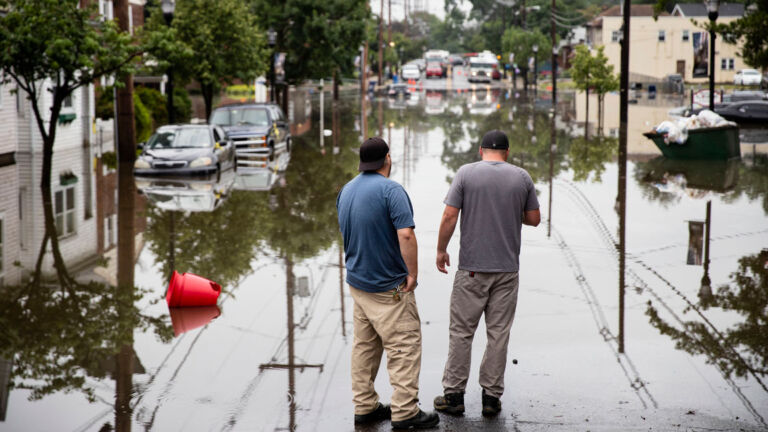
LaTourette said it may be theoretically possible for the state to use eminent domain to buy out flood-prone properties, but he was unaware of any such discussions. “I’ve not been part of any conversation where the prospect is utilizing eminent domain in order to force folks into buyout,” he said.
Under a process called Protecting Against Climate Threats, the DEP is writing new land-use rules that will place new requirements on anyone wanting to build in flood-prone areas. But LaTourette has previously said the new rules won’t ban new construction in certain places, and argued Tuesday that any such hard-line approach would fail to sway people.
“I don’t believe we are going to be able to help the public really appreciate risk by having the big ‘or-else’ hammer sitting on the side,” he said. “These are consequential decisions that we have to make as communities.”
