
By Young Soo Yang
The desire to know where we come from is an all too human one, especially in a country that is defined by the immigrant experience. This desire is reflected in the countless societies based on kinship relations, large-scale family reunions that bring together distant family members from around the country and the fairly recent popularity of do-it-yourself genealogical research.
A PBS series that is getting a lot of attention these days is Finding Your Roots with Henry Louis Gates, Jr.. The program traces the ancestral pasts of some well-known figures like Barbara Walters, Condoleezza Rice, Kevin Bacon and Newark Mayor Cory Booker.
The episode featuring Cory Booker juxtaposes his family’s story with that of Civil Rights leader John Lewis. The mayor learns the identity of his maternal great grandfather, and in the process, finds new family connections he never knew he had. He and his parents also learn of the origins of the Booker family name. In one scene, the mayor’s father is visibly shaken as he is presented with the findings.
RELATED VIDEO: Finding Your Roots: Cory Booker
Cory Booker and his father learn about his early 20th-century ancestors and the origin of the Booker family name. Click here to watch the full episode.
Booker told POLITICO that the knowledge of his past gives his public service even more meaning: He said the awareness of poverty and dislocation in his own family made increasing services like homeless housing personal. Said Booker, “if my father’s mother, who was a single mother, if she didn’t get the help and support that she needed, I wouldn’t be here today.”
Stories like that of Cory Booker are common among those who embark on a search into their ancestry.
The Internet has made genealogical research more accessible to the average person. Web-based commercial services like ancestry.com have made it easy to start a search.
New Jersey is full of fascinating history and the state library is a great warehouse of documentation about the early years of the state as well as the colony before that. John Shaw, a reference librarian at the New Jersey State Library, gives workshops throughout the year that provide a beginner’s how-to guide on genealogical research.
The whole idea of genealogy, Shaw says, is to find the records of living ancestors that are still findable and use them to identify all the links in a family as far back in time as one can.
He says he has definitely seen a rise in the number of people getting involved in genealogy, attributing the increased interest to shows like Finding Your Roots as well as the effective marketing of pay sites like ancestry.com. He says access to the site’s services, which the library makes available for free, is the most used resource at the library.
“They have without question the largest amount of genealogical information on the web available … I mean just the census surveys are worth a goldmine alone,” Shaw said. “At one time, they had over 4,000 different databases of one sort or another available. So it’s a massively useful and reliable service.”
In addition to ancestry.com, Shaw cites census records as one of the first places people go to when searching for relatives.
“So from the census you could find out where people were living, approximate dates of things like birth and marriage, other family members. And taking that kind of information, you could then find vital records … birth, marriage and death. And they usually lead you back generations and then you start looking for other things like wills, naturalizations.”
“For instance, you can find an index to wills here at the library. If you want the will itself, you have to go to the New Jersey State Archives where they file the wills. But we have indexes to them and indexes to other kinds of records.”
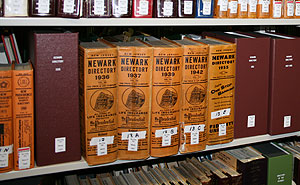
Libraries like the state library can also be rich repositories of city directories. These early precursors to phone books list every person who lived in a town. The state library has some going back before the 1840s. A city directory, Shaw says, will reveal not only a person’s house address but the kind of business or occupation he or she held.
“And if you trace them from year to year, you can find out where they moved to and approximately when they moved and you can also find out when they passed away.”
Knowing the date of death of a relative can lead to a rich source of information. The state library has an excellent collection of newspapers from the state’s major cities such as Trenton, Newark, Camden and Jersey City. According to Shaw, one of the most common things people look for at the library are obituaries, which reveal not only where a relative is buried but other nuggets of family information.
“A lot of people want to know where their ancestors were married and that’s sometimes difficult information to come by. And sometimes an obituary is the only place that’ll tell you.”
A look into one’s family tree can result in unpleasant findings. “You never know what you’re going to find,” says Shaw. Having assisted library patrons in their genealogical research, he has seen people uncover dark family secrets.
He recently did some research on one family who had records from the Daughters of the Revolution (DAR) which indicated a revolutionary war service by a family member. The war service, however, may not have been an honorable one.
“We located letters and things like that that indicated that he was consorting with the British which was kind of interesting. So, hero or traitor, who knows?”
For people without historical documentation, scientific advancements like DNA testing can be used to fill in the missing links.
Says Shaw, “It’s especially interesting in the African-American community cause if you’re in a community that basically didn’t have records past the time they were forced to come to the U.S., then there really isn’t much else to work with.”
But DNA testing, says Shaw, is limited by the number of DNA samples in the database.
“One of the things about DNA testing – the more people that get tested, the larger the databases are available to do comparison which means the more you can find out about your own family. So there’s a tremendous effort to do lots of DNA testing so they can establish a large base of samples.”
“Why am I who I am? … Why am I at this place? … Why do I look the way I do and act the way I do to some extent?”
According to Shaw, these deeply probing questions seem to gain strength as we mature in life –- which is not the optimum time to start a genealogy search. His advice is that the next time grandma decides to tell the old family stories, pay attention.
“What I get in here mainly are people in their 50s, 60s and 70s who have suddenly gotten this interest in learning about their family. And one of the big challenges in genealogical research is often people get interested in genealogy just at the point where all the relatives have passed away who could have told them about the family.”
John Shaw, Reference Librarian, Genealogy & Local History, runs a three-part genealogy workshop at the New Jersey State Library. The next lecture titled “Genealogy 3: Locating Vital Records” will be held May 8, 2012 at noon. For more information, visit njstatelib.org or call 609-278-2640.