
By NJ Today Contributor Tom Meyers
Universal Studio founder Carl Laemmle first came to Coytesville in 1909 when he operated the Independent Motion Picture Company (IMP) and shot his first film, Hiawatha. In 1912 Laemmle purchased the Champion Studio on Fifth Street. This studio, built in 1910 by Mark Ditenfass, was the first studio built in Fort Lee and today still stands and is operated as a printing plant. This structure is the oldest standing movie studio building in America. Once Laemmle purchased this building, he amassed a number of smaller studios. He had everything but a name for his new studio. Inspiration came when one day while peering out of his New York City office building, he saw a passing truck with the name “Universal Plumbing.” Thus Universal Studio was born 100 years ago with its first studio in Fort Lee.
In 1914, Laemmle broke ground on a much larger Universal Studio on Main Street opposite Jones Road in West Fort Lee. This studio for a time was the largest studio in the world yet it was set in the very rural town of Fort Lee. Once the studio opened, Laemmle realized he lost all water pressure on Mondays and essentially the studio could not operate. Why? Because Monday’s were wash days in Fort Lee and all the woman of Fort Lee used the water at the same time to do their weekly laundry. So Laemmle sidestepped this problem by erecting a large water tower which stood above this property until it and the studio where razed in 1964 to make way for Bonded Film Storage.
The Universal Studio on Main Street saw one large production in 1915, the ambitious Universal film 20,000 Leagues Under the Sea, which was released in 1916. Shortly thereafter, Universal centered all their film production out in Universal City in California, which opened in 1915. Though Universal retained their two studios in Fort Lee through 1931, they were leased to other producers such as Sam Goldwyn and Lewis Selznick.
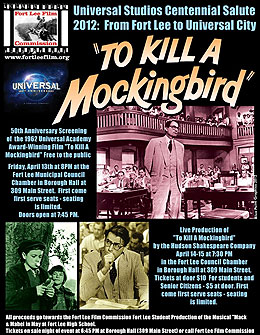
All proceeds from these performances will go towards the Fort Lee Film Commission production of the Jerry Herman musical Mack & Mabel. This musical features Fort Lee High School drama department actors and is directed by Fort Lee High School drama department teacher Jodi Etra. This musical is about the founding of Keystone Studio here in Fort Lee by Mack Sennett and Mabel Normand in 1912. The play will be held at the Fort Lee High School Auditorium on May 18 at 7:30 p.m. and May 19 at 2 p.m. and 7:30 p.m. Tickets are $10 at the door the night of the performance.
The Fort Lee Film Commission has created Universal-centric events for this centennial year — a historic jitney tour on June 24 where we will unveil two new commemorative street signs at the locations of the two Universal Studios in Fort Lee; a Fort Lee Museum exhibit running from July 7 through the end of the year on Universal Studio that will include the display of rare archival photos and artifacts from the studio when it was in Fort Lee; a 10-week free summer long outdoor “Movies & Music Under the Stars” program on the outdoor stage of the Jack Alter Fort Lee Community Center (1355 Inwood Terrace) that will run each Saturday night from July 7 through September 8 and will include a screening of 10 Universal films courtesy of Universal Studios; and a Universal horror film festival in October. All this to salute the greatest movie studio in the world that was born in Fort Lee 100 years ago.
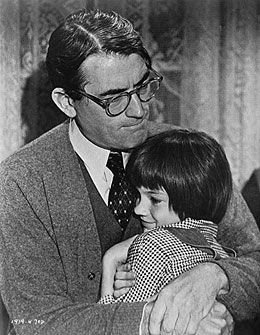
Now back to the film To Kill a Mockingbird. This film, as already noted, was based on the wonderful Harper Lee novel. She wrote of a time in America when one man could stand up in his small community and make a difference at the risk of his life. To center an American novel on the topic of racial injustice was a rare thing to do at the dawn of the 1960s when the book was published. So join us in Fort Lee on April 13, 14 and 15 as we showcase the work of another Lee, Miss Harper Lee, and if you can, bring your children and grandchildren and introduce them to Atticus Finch, Scout, and Boo Radley.
Tom Meyers is the Executive Director and founder of the Fort Lee Film Commission, a former Fort Lee Councilman, founder of the Fort Lee Historic Committee, and a member of the Fort Lee Historical Society.